Cambodia’s Industrial & Logistics Real Estate Is the ASEAN Opportunity Nobody Talks About
$28 Billion in Factory Investment. 56 Special Economic Zones. A $1.7 Billion Canal. The Industrial Property Play Is Here.
The Sleeping Giant of ASEAN Industrial Real Estate
When investors discuss industrial real estate in Southeast Asia, the conversation revolves around Vietnam, Thailand, and Indonesia. Cambodia rarely enters the discussion. This oversight is precisely where the opportunity lives. Cambodia’s industrial and logistics property market is at an inflection point. The data tells a story that sophisticated investors are beginning to notice, and the window to enter at favorable terms is open right now.
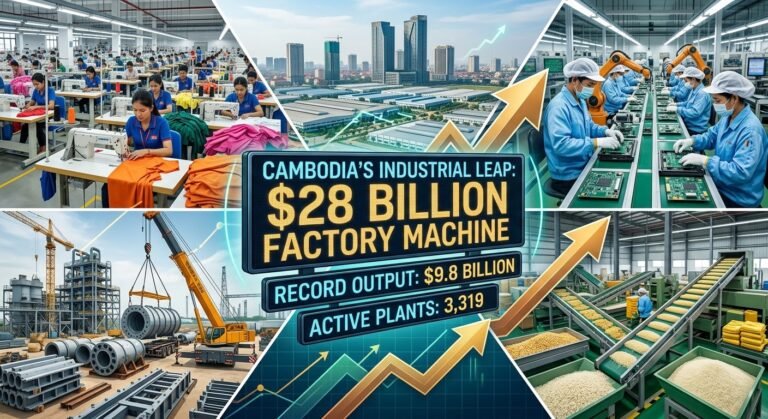
Consider the headline numbers. Cambodia’s industrial sector is home to $28 billion in total factory investment, a 29 percent surge from the previous year. Manufacturing output tops $9.8 billion. The country registers 845 new factories in the first six months of 2026 alone. Each of these factories requires land, buildings, warehousing, and logistics space. This is not a forecast. This is existing demand that the industrial real estate market is struggling to meet.
The global industrial real estate market is valued at $294 billion in 2026 and is projected to reach $360 billion by 2030, growing at 5.2 percent annually. The warehouse and logistics real estate segment is growing even faster, at 7 percent CAGR, from $61 billion to $110 billion by 2035. Cambodia is positioned to capture a disproportionate share of this growth because its starting base is small and its demand trajectory is steep. When a market grows from a low base with high demand, the returns for early movers are exceptional.
$28 Billion in Factory Investment: The Demand Engine for Industrial Property
The most reliable driver of industrial real estate demand is manufacturing investment. When companies build factories, they need land. When they produce goods, they need warehouses. When they ship products, they need logistics hubs. Cambodia is experiencing all three demand vectors simultaneously, and the scale is accelerating.
Cambodia’s factory investment surges 29 percent to reach $28 billion, with manufacturing output exceeding $9.8 billion annually. The CDC approves 146 investment projects worth $2.5 billion in Q1 2026 alone, and the full year of 2025 sees 630 projects worth nearly $10 billion. The majority of this capital flows directly into manufacturing facilities, and each facility generates demand for industrial land, ready-built factories, and warehouse space.
The composition of manufacturing is also shifting in a way that demands higher-quality industrial real estate. Traditional garment factories require basic structures. But the new wave of investment in electronics assembly, automotive parts production, solar equipment manufacturing, and electric vehicle assembly requires modern facilities with stable power, climate control, clean rooms, and advanced logistics connections. This upgrade in manufacturing sophistication translates directly into higher-specification industrial real estate and higher rental premiums for developers who can deliver the right product.
Cambodia’s SEZ Network: 56 Zones Across 5 Key Industrial Corridors
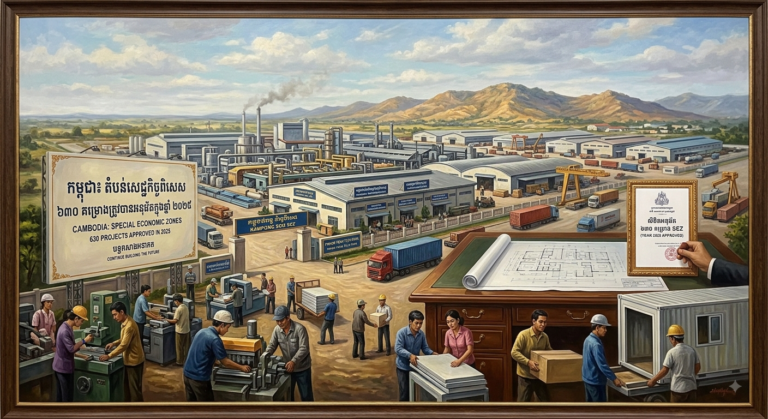
Cambodia’s Special Economic Zone network is the backbone of its industrial real estate market. According to the Council for the Development of Cambodia, the country has 56 SEZs, with 33 currently operational, managed by 28 developers. These zones span 11 provinces and are concentrated along five major industrial corridors. For industrial real estate investors, understanding this geography is essential because SEZ locations determine demand density, tenant quality, and exit liquidity.
| SEZ Corridor | Key Zones | Strengths | Primary Tenants |
|---|---|---|---|
| Phnom Penh | PPSEZ | Largest workforce, airport, government proximity | Garments, electronics, food processing |
| Sihanoukville | SV SEZ 1, SV SEZ 2 | Deep-sea port, China-backed infra | Shipping, heavy industry, logistics |
| Bavet (Svay Rieng) | Tai Seng Bavet | Vietnam border, RCEP corridor | Electronics, auto parts, packaging |
| Poipet | Poipet SEZ, Koh Kong SEZ | Thailand border cross-trade | Garments, agriculture processing |
| Kandal / Surrounding | Multiple zones | Phnom Penh overflow, highway access | Light manufacturing, warehousing |
The strategic positioning of these zones reveals a clear logistics logic. Phnom Penh serves as the central hub with the largest labor pool and airport access. Sihanoukville provides the deep-sea port connection for international shipping. Bavet and Poipet sit on the borders with Vietnam and Thailand respectively, enabling cross-border manufacturing supply chains under RCEP trade preferences. This multi-corridor structure means industrial demand is not concentrated in a single location. Investors can choose their risk profile by selecting corridors that match their investment thesis.
For real estate investors, the critical metric is occupancy. SEZs with high occupancy rates and waiting lists for factory space represent the tightest markets with the strongest rental pricing power. New SEZ developments currently under construction represent the growth frontier, where early land acquisition at lower cost offers the highest return potential. The CDC’s active approval of new zones suggests that government policy is aligned with expanding industrial capacity, which provides a supportive backdrop for industrial property development.
The Cost Advantage: Cambodia Undercuts Every Competitor
In industrial real estate, rental cost is the fundamental value proposition. Tenants choose locations based on operating costs, and Cambodia offers the most competitive industrial rental rates in mainland Southeast Asia. This cost advantage is not marginal. It is structural, and it persists because Cambodia’s industrial land supply is still expanding while demand is growing faster than supply.
| Market | Factory Rental (USD/sqm/mo) | Industrial Land Lease | Min Wage (USD/mo) |
|---|---|---|---|
| Cambodia (avg) | $3.05 | $50-80/sqm/term | $210 |
| Vietnam (Tier 1) | $4.70-4.90 | $70-145/sqm/term | $250-300 |
| Thailand (Bangkok) | $5.50-7.00 | $120-162/sqm/term | $330-370 |
| Indonesia (Jakarta) | $5.00-6.50 | $100-150/sqm/term | $240-280 |
These numbers tell a compelling story. Cambodia’s average ready-built factory rental rate of $3.05 per square meter per month is 35 to 55 percent lower than comparable rates in Vietnam’s tier-one markets and 50 to 65 percent lower than Bangkok. Industrial land lease rates follow a similar pattern. For a manufacturer operating a 10,000 square meter facility, the annual rental savings in Cambodia compared with Vietnam range from $200,000 to $230,000. Compared with Thailand, the savings exceed $300,000 per year. These are not theoretical differences. They are real cost reductions that directly impact the bottom line of manufacturing operations.
For the industrial property investor, this cost advantage creates a powerful demand driver. As long as Cambodia remains significantly cheaper than neighboring markets, manufacturers have a financial incentive to locate or relocate their operations there. This is not dependent on government policy or market sentiment. It is based on hard arithmetic that any CFO can verify. The cost gap also provides a buffer: even if Cambodia’s industrial rents rise by 20 to 30 percent over the next five years, the country remains competitive. This gives investors confidence in the durability of rental income streams.
Funan Techo Canal: The $1.7 Billion Logistics Game-Changer
No discussion of Cambodia’s industrial real estate is complete without the Funan Techo Canal. This is the single largest infrastructure project in Cambodia’s history, and its impact on industrial property values along the corridor will be transformative. The canal is a 180-kilometer inland waterway connecting Phnom Penh to Kep province on the Gulf of Thailand, with an estimated cost of $1.7 billion and a construction timeline of approximately four years. Completion is expected around 2029.
The canal’s economic impact is substantial. According to government and independent estimates, the Funan Techo Canal reduces Cambodia’s logistics costs by up to 30 percent. Currently, Cambodia depends heavily on Vietnam’s ports for international shipping. The canal gives Cambodia direct maritime access, eliminating transshipment costs, reducing transit times, and giving the country strategic independence over its export logistics. For industrial property investors, this is a value catalyst. Industrial land and warehouse properties along the canal corridor stand to benefit from increased demand, higher occupancy, and rental rate appreciation as the canal approaches completion.
Prime Minister Hun Manet highlights the canal as a cornerstone of Cambodia’s economic strategy, noting that it strengthens logistics networks and connects Cambodia more deeply with regional trade routes. The canal corridor is already attracting interest from logistics companies, warehousing developers, and manufacturing firms that need port-adjacent facilities. For investors who acquire industrial land along this corridor now, the four-year construction period provides a clear timeline for value appreciation. Industrial property purchased today at current prices is likely to command significantly higher rents once the canal is operational.
Phnom Penh Logistics Complex: The $220 Million Integrated Hub
While the Funan Techo Canal captures headlines, the Phnom Penh Logistics Complex, or PPLC, is the institutional-grade logistics project that signals where Cambodia’s industrial real estate market is heading. This is a $220 million public-private partnership developed by Singapore’s YCH Group, one of Asia’s most established logistics companies. The project is nearing completion and is designed to serve as Cambodia’s first fully integrated supply chain hub.
The PPLC represents a step-change in Cambodia’s logistics infrastructure. Traditional logistics in Cambodia relies on fragmented warehousing, often basic structures with limited technology. The PPLC brings international-standard facilities including modern warehousing, cold chain storage, cross-docking facilities, and integrated transport connections. The involvement of the International Finance Corporation and the Asian Development Bank in the project’s development framework adds multilateral credibility and de-risks the investment thesis.
For industrial property investors, the PPLC is important for two reasons. First, it establishes a new benchmark for logistics real estate quality in Cambodia, which supports rental rate growth across the market as tenants upgrade their requirements. Second, it demonstrates that institutional-grade developers are willing to commit significant capital to Cambodia’s logistics sector. When Singapore’s YCH Group invests $220 million in a Cambodian logistics facility, it signals that the fundamentals are sound and the returns are attractive. This kind of anchor investment draws follow-on capital from other developers and investors.
Cold Chain and Smart Warehousing: The Next Frontier
Cambodia’s cold chain logistics market is one of the most underserved segments of the industrial real estate sector, and that undersupply creates opportunity. The country’s cold chain market share grows from 3.5 percent in 2010 to 15.1 percent in 2023, but this figure remains well below the regional average. The ASEAN cold chain logistics market is valued at $19.98 billion in 2026 and is growing at 4.94 percent CAGR to reach $24.43 billion by 2031. Cambodia’s share of this market is currently small, which means the growth potential is outsized.
The demand drivers for cold chain facilities in Cambodia are strong and accelerating. Cambodia exports more than $4.18 billion in agricultural products, including rice, cassava, cashews, rubber, bananas, and the increasingly important durian trade. Durian exports to China alone are growing rapidly, and each shipment requires temperature-controlled storage and transport. The government identifies cold chain logistics, smart warehouses, and logistics centers as priority investment sectors through the Cambodian Investment Board. The 2021 Law on Investment provides incentive packages for qualifying projects in these areas.
For property investors, cold chain warehousing offers a compelling value proposition. The technical complexity of cold chain facilities creates a higher barrier to entry, which limits competition and supports premium rental rates. The specialized nature of the product means tenants are sticky because moving a cold chain operation is expensive and disruptive. Investors who develop or acquire cold chain facilities in Cambodia benefit from both higher yields and longer tenant retention compared with general warehousing.
Manufacturing Upgrade: From Garments to Electronics and Beyond
The evolution of Cambodia’s manufacturing sector has direct implications for industrial real estate requirements. For decades, Cambodia’s manufacturing is dominated by garments and textiles. This industry requires basic factory structures, employs large numbers of workers, and generates demand for low-cost industrial space. While garment manufacturing continues to grow, the real story is the diversification into higher-value manufacturing.
Electronics assembly, automotive parts production, electric vehicle assembly, solar equipment manufacturing, and tyre production are all expanding rapidly. These industries require modern industrial facilities with features that garment factories do not need: reinforced flooring for heavy machinery, raised floors for cable management, enhanced electrical capacity, climate-controlled environments, and clean room specifications. This manufacturing upgrade creates demand for a new class of industrial real estate that commands higher rents and attracts higher-quality tenants.
The geographic shift is equally important. Bavet SEZ on the Vietnam border and Poipet SEZ on the Thailand border are attracting electronics and automotive parts manufacturers who want to integrate into cross-border supply chains. The RCEP trade agreement facilitates tariff-free movement of components between Cambodia, Vietnam, Thailand, and China, which makes border-zone industrial locations especially attractive. For investors, this means that SEZ land and ready-built factories in Bavet and Poipet offer exposure to the highest-growth segments of Cambodia’s manufacturing upgrade.
The Yield Proposition: Why Cambodia Delivers 7-10% Returns in USD
Yield is the ultimate measure of an industrial real estate investment, and Cambodia delivers yields that are simply not available in neighboring markets. Gross rental yields for industrial and logistics properties in Cambodia range from 7 to 10 percent, depending on location, asset quality, and tenant profile. By comparison, equivalent industrial properties in Bangkok generate 4 to 5 percent, Ho Chi Minh City delivers 3 to 5 percent, and Jakarta offers 5 to 7 percent. Cambodia’s yield premium is significant and persistent.
The yield advantage is amplified by Cambodia’s dollarized economy. The US dollar is the dominant business currency, which means industrial rents are typically denominated in USD. For dollar-based investors, this eliminates currency risk entirely. Your rental income and property value are in the same currency as your investment capital. In Vietnam, Thailand, and Indonesia, local currency depreciation against the dollar erodes returns for foreign investors. In Cambodia, this risk does not exist.
The combination of high yields and zero currency risk makes Cambodia’s industrial real estate one of the most attractive risk-adjusted returns in ASEAN. A 7 percent USD-denominated yield in Cambodia compares favorably with a 4 percent yield in Vietnam that carries 2 to 4 percent annual currency depreciation risk. On a risk-adjusted basis, Cambodia’s industrial property returns are competitive with or superior to every neighboring market. This is not a speculative observation. It is based on current market data and the structural features of Cambodia’s monetary system.
Risk Factors Every Industrial Investor Should Weigh
No investment is without risk, and Cambodia’s industrial real estate market has specific factors that require careful consideration. The key is not to avoid risk but to understand it and develop strategies to manage it effectively.
Infrastructure reliability. While major infrastructure projects are underway, power reliability and road quality in some areas still lag behind regional standards. The mitigation is straightforward: focus investments on established SEZs and industrial corridors where infrastructure is proven or under active upgrade. Phnom Penh SEZ, Sihanoukville SEZ, and Bavet SEZ all have reliable power and road access. The Funan Techo Canal and Phnom Penh Logistics Complex further improve the infrastructure outlook.
Tenant quality and lease enforcement. Cambodia’s commercial legal system continues to develop. Lease enforcement and dispute resolution are less predictable than in mature markets. The solution is to work with established SEZ operators who manage tenant relationships and provide legal infrastructure. SEZs offer a more structured environment with clearer rules and established dispute mechanisms.
Liquidity and exit timing. Cambodia’s industrial property market is less liquid than Thailand or Vietnam. Finding a buyer for a large industrial asset takes longer, and price discovery is less efficient. The mitigation is to invest in assets with strong cash flow that you are comfortable holding for five to ten years. The high yield compensates for the lower liquidity. Additionally, as more institutional investors enter Cambodia, market liquidity is improving steadily.
Regulatory evolution. Cambodia’s property and investment regulations continue to develop. Tax policies, zoning rules, and environmental requirements are evolving. The approach is to engage a reputable local law firm with experience in Cambodian industrial property and to structure investments through proper legal channels. The 2021 Law on Investment and QIP incentive framework provide a stable foundation, but local expertise remains essential.
Investment Playbook: Where to Deploy Capital Now
The data is clear. Cambodia’s industrial and logistics real estate market offers a rare combination of high yield, low entry cost, strong demand growth, and currency stability. The question is how to translate these macro conditions into a concrete investment strategy. Here are four actionable approaches for different investor profiles.
Ready-built factory development in SEZs. For developers and operators, building ready-built factories in established SEZs offers the most direct exposure. Target zones in Phnom Penh and Bavet where occupancy rates are high and waiting lists exist. A standard factory of 3,000 to 5,000 square meters costs significantly less to build in Cambodia than in Vietnam or Thailand, while rental rates offer a wider margin. With the QIP incentive package, your tenant enjoys tax benefits that make your factory more attractive than competing options in neighboring countries.
Canal corridor land banking. For investors with a longer time horizon, acquiring industrial land along the Funan Techo Canal corridor offers the highest return potential. The canal is under construction with expected completion around 2029. Land prices along the corridor are still at pre-canal levels but are likely to appreciate significantly as the project advances. This is a four-year value creation window with a clear catalyst.
Cold chain facility development. For investors seeking higher yields and tenant stickiness, cold chain warehousing is the most underserved segment. Cambodia’s agricultural export growth, particularly durian and fresh produce to China, drives urgent demand for temperature-controlled logistics facilities. The technical complexity limits competition and supports premium rental rates. Government incentives through the CIB and the 2021 Investment Law provide additional support for qualifying projects.
Logistics warehousing in Phnom Penh. For income-focused investors, modern logistics warehousing in the Phnom Penh area offers stable cash flow with 7 to 9 percent USD yields. The Phnom Penh Logistics Complex is establishing quality benchmarks that support rental growth across the market. E-commerce growth and the expansion of distribution networks by retailers and manufacturers create sustained demand for well-located warehouse space.
Cambodia’s industrial real estate market is where Vietnam’s market was a decade ago: low costs, high growth, and limited competition from institutional capital. The investors who enter now, while the market is still inefficient and yields are high, are the ones who capture the outsized returns that early movers always enjoy. The data supports the thesis. The infrastructure is coming online. The tenants are already lining up. The only question is whether you are ready to act.