
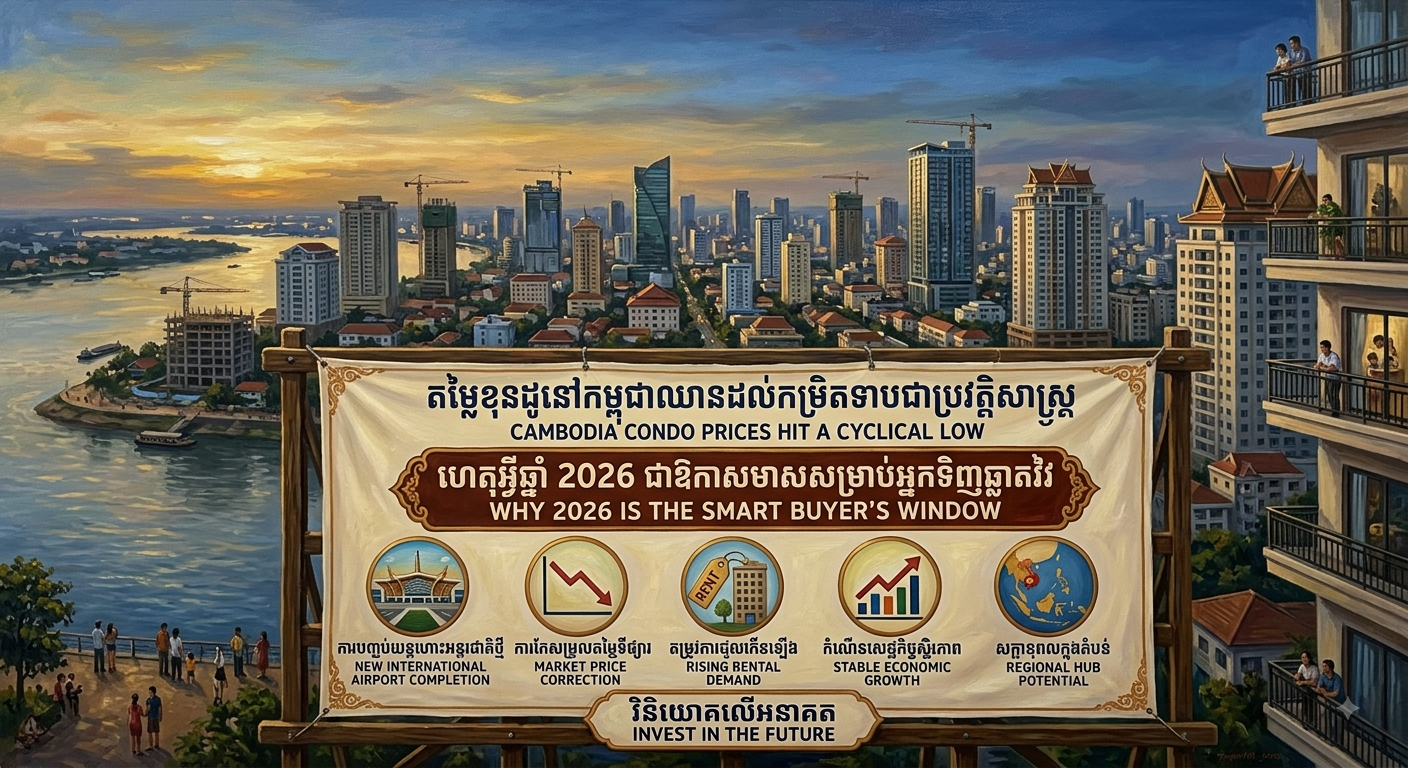
Cambodia Condo Prices Hit a Cyclical Low: Why 2026 Is the Smart Buyer’s Window
Cambodia’s condo market is on sale. Prices in Phnom Penh fall 8.1% in 2026, and 11.4% after adjusting for inflation. The market has been weak since the post-pandemic correction began. Developers offer discounts. Buyers negotiate hard. Transactions slow. For most people, this looks like a market to avoid. For smart investors, this is exactly the market cycle they wait for. The entry prices are the lowest in five years. Rental yields remain above 7%. Foreigners can own 100% freehold title. And the long-term growth drivers, including $4.7 billion in new investment and a construction sector growing at 6.6%, are still in place. This article explains why Cambodia’s condo market in 2026 offers a genuine opportunity for patient, value-focused investors.
Every data point in this piece comes from verified public sources including Global Property Guide, the Wandering Investor, IPS Cambodia, Realestate.com.kh, the Cambodia Constructors Association, and the Global Practice Guides.
What Is Happening to Condo Prices
Let’s start with the numbers. Phnom Penh’s residential property market is in its third year of price correction. Condo sale prices decline by 8.1% in nominal terms in 2026. After adjusting for Cambodia’s 5.1% inflation rate, the real decline is 11.4%. In January 2026, the annual inflation rate is just 1.26%, so the early-year price data is relatively clean. The correction is broad-based across most districts, but the premium areas hold better than the periphery.
The current price zones in Phnom Penh are clear. The BKK1 district, which is the premium golden mile, trades at $2,300 to $3,200 per square meter. Tonle Bassac, which sits just south of the city center along the river, offers similar quality at slightly lower prices. BKK2, BKK3, and Toul Kork provide mid-range options between $1,000 and $2,000 per square meter. For comparison, equivalent properties in Bangkok cost more than twice as much per square meter. In Singapore, the multiple is even higher. Cambodia is cheap by any regional standard.
The correction is not a crash. It is a cyclical adjustment. Cambodia’s construction sector approved 630 new projects in early 2026, with fixed-asset investments worth $10 billion, a 45% year-on-year increase. Too many condo units are built too fast, particularly in the mid-range segment. The market needs time to absorb the oversupply. Weak buyer sentiment compounds the problem. But the underlying demand drivers, including population growth, urbanization, rising incomes, and foreign investment inflows, remain intact. The question is timing. And for investors who buy during the low, the timing is the advantage.
Rental Yields Tell a Different Story
Here is the number that makes Cambodia’s condo market interesting despite falling prices. Rental yields in Phnom Penh range from 5.22% to 7.4% in Q1 2026, with a city-wide average of 6.5%. Condo investors earn about 7.5% annually on their rental income. Compare this to Thailand at 6.5% and Japan at 5.5%. Cambodia offers the highest condo yields in mainland Southeast Asia. Higher yields at lower entry prices create a compelling yield-on-cost equation for new buyers.
How does this work in practice? A two-bedroom condo in BKK1 that costs $120,000 might rent for $750 to $900 per month. That puts the gross yield between 7.5% and 9%. After factoring in management fees, maintenance, and occasional vacancy, the net yield still sits in the 5% to 6% range. In a world where savings accounts in developed markets pay 3% to 4%, a net yield of 5% to 6% from a tangible asset in a growing emerging market is attractive. And if the investor buys during the current price correction, the yield-on-cost is even higher because the purchase price is lower.
The rental demand is real and growing. Cambodia’s middle class expands as the economy creates formal jobs. The 276 investment projects approved in H1 2026 are expected to create 160,000 new jobs. These workers need housing. Many of them are young professionals who prefer modern condo living to traditional housing. The demand side of the equation is strengthening at exactly the same time that prices are correcting. This convergence is what creates the opportunity.
The Foreigner Advantage: 100% Freehold
Cambodia offers something that most of Southeast Asia does not. Foreign nationals can legally own condominium units with 100% freehold strata title. There is no leasehold countdown. No need for complex corporate structures. No 30-year renewal uncertainty. You buy the condo, you own it outright, and the title is in your name permanently. This is a level of property rights that investors associate with markets like Singapore or Hong Kong, not with a frontier emerging market.
The rules are straightforward. Foreigners can own units in strata-title buildings from the first floor upward. Ground floor and underground units are excluded. Foreign ownership is capped at 70% of the total private units in any given building. The remaining 30% is reserved for Cambodian nationals. In practice, most well-managed condo buildings in Phnom Penh have no trouble staying within this limit. The strata title system is modeled on international standards and is recognized by Cambodia’s Land Law.
For investors comparing across ASEAN, the difference is significant. Thailand restricts foreign ownership to 49% of a condo building and imposes additional requirements. Vietnam does not allow foreign freehold ownership of apartments at all. Indonesia limits foreign ownership to apartments above a certain price floor and restricts the title type. Cambodia’s 70% foreign ownership cap and full freehold title make it one of the most foreign-investor-friendly property markets in the region. Analysts call Cambodia the last freehold frontier in Asia for a reason.
Tax Rules in 2026: What Changed
Tax policy is a critical factor in any property investment decision. Cambodia makes several changes in 2025 and 2026 that investors need to understand. The most significant change is the introduction of capital gains tax on the sale or transfer of leases, intellectual property, and foreign currencies, effective from January 1, 2026. This tax is set at a rate that applies to the gain portion of the transaction, not the full sale price.
However, as of March 2026, Cambodia does not impose capital gains tax on residential property sales. The legislation for property CGT is still in draft form and has not been enacted. This means an investor who buys a condo today and sells it in three or five years may face no capital gains tax on the profit. Property transfer tax, commonly known as stamp duty, remains at 4% of the property’s transactional value. This tax is payable within three months of the transfer and is typically the responsibility of the buyer unless otherwise agreed.
The tax environment for property investment in Cambodia is straightforward compared to many other countries. There is no annual property tax on primary residences for Cambodian citizens. There is no stamp duty on mortgage registration. The 2021 Law on Investment provides additional tax incentives for qualifying investment projects, including income tax holidays and import duty exemptions. For a property investor who holds units long-term and collects rental income, the ongoing tax burden is light.
| Indicator | Value | Source |
|---|---|---|
| Condo Price Change 2026 | -8.1% nominal (-11.4% real) | Global Property Guide |
| BKK1 Price Range | $2,300-$3,200/sqm | Realting / IPS Cambodia |
| Mid-Range Price Range | $1,000-$2,000/sqm | Market Listings |
| Phnom Penh Avg Rental Yield | 6.5% | Global Property Guide, Q1 2026 |
| Condo ROI (Annual) | ~7.5% | ERA Cambodia |
| Thailand Condo Yield | ~6.5% | Market Data |
| Japan Condo Yield | ~5.5% | Market Data |
| Foreign Ownership Cap | 70% of condo building | Cambodia Land Law |
| Foreign Ownership Type | 100% Freehold Strata Title | Cambodia Land Law |
| Property Transfer Tax | 4% of transaction value | Tax Prakas 2026 |
| Residential CGT | Not yet enacted (draft) | Market Analysis, Mar 2026 |
| Construction Growth 2026 | 6.6% | Cambodia Constructors Assoc. |
| Construction Growth 2027-2030 | 8.2% avg annual | Industry Forecasts |
Source: Global Property Guide, IPS Cambodia, Realting, ERA Cambodia, Cambodia Constructors Association (2025-2026)
Where the Smart Money Goes: Location Strategy
Location matters more than ever in a correcting market. Not all condos in Phnom Penh are equal. The districts that hold value best during the downturn are the ones that offer the strongest fundamentals for long-term appreciation.
BKK1 remains the gold standard. It is the central business district, the diplomatic quarter, and the area with the highest concentration of international restaurants, co-working spaces, and premium retail. Condos here hold their value better than anywhere else in the city. The yields are slightly lower than the city average, but the capital appreciation potential over a five to ten-year horizon is stronger because of limited land supply in the area.
Tonle Bassac sits just south of BKK1 along the riverfront. It offers a similar lifestyle at prices that are 10% to 15% lower than BKK1. The area benefits from several major development projects including Aeon Mall 2 and improved road connections. For investors who want BKK1 quality at a better price, Tonle Bassac is the most logical choice. Analysts identify it as a growing opportunity within Phnom Penh’s real estate landscape.
BKK2, Toul Kork, and Chroy Changvar offer the highest yields but come with higher risk. These areas attract Cambodian professionals and expat workers who need affordable modern housing. The entry prices are lower, the yields are higher, but the capital appreciation potential is more uncertain. For yield-focused investors, these areas are worth exploring. For investors who prioritize capital preservation and long-term appreciation, BKK1 and Tonle Bassac remain the safer choices.
The Long-Term Case: Construction and Investment Keep Growing
Here is the number that puts the current price correction in perspective. Cambodia’s construction sector grows at 6.6% in 2026. From 2027 to 2030, the average annual growth rate is projected at 8.2%. The country approves 630 new projects worth $10 billion in early 2026, a 45% year-on-year increase. The CDC approves 276 investment projects worth $4.7 billion in H1 2026, creating 160,000 new jobs. Foreign direct investment reaches $5.1 billion in 2025.
These numbers describe an economy that is expanding its physical footprint rapidly. New roads, new airports, new SEZs, new factories, and new commercial developments are under construction across the country. Each new infrastructure project increases the value of nearby real estate. Each new factory creates jobs that generate housing demand. Each new international connection, like the direct flights from Techo International Airport, brings more foreign professionals and business travelers who need quality accommodation.
The Funan Techo Canal, the World Bank’s $300 million transport program, and the $1.5 billion Siem Reap airport are all infrastructure projects that will reshape the geography of Cambodian real estate over the next five to ten years. Investors who buy property in the right locations today are positioning themselves ahead of these transformations. The construction sector’s projected 8.2% annual growth through 2030 means that Cambodia’s built environment is improving continuously. The quality of properties, roads, utilities, and public spaces is on an upward trajectory. This structural improvement supports long-term property values regardless of the current cyclical downturn.
What This Means for You as an Investor
Cambodia’s condo prices are at a cyclical low. Rental yields remain above 7%, the highest in mainland Southeast Asia. Foreigners can own 100% freehold title with a 70% building ownership cap. Property transfer costs are low at 4%. Capital gains tax on residential sales has not been enacted. Construction and investment keep growing at double-digit rates. The long-term infrastructure buildout, including Techo Airport, the Funan Techo Canal, and the World Bank transport program, supports future property appreciation.
If you are a value investor looking at Southeast Asian real estate, Cambodia in 2026 offers what value investors look for: low entry prices, strong income yields, favorable ownership rights, and positive long-term growth catalysts. The market is not going to rebound overnight. But the investors who buy during the low are the ones who capture the highest returns when the cycle turns. The data is public. The yields are real. The title is freehold. The question is whether you act while the window is open.
Disclaimer: This article is for informational purposes only and does not constitute financial advice. All data is sourced from public authorities and verified news outlets. Investors should conduct their own due diligence before making any investment decisions.