Cambodia’s $28 Billion Factory Machine: Industrial Output Hits Record $9.8B as 3,319 Plants Drive the Next Economic Leap
With 29% investment growth, 1.8 million workers, and a 2029 LDC graduation deadline, Cambodia’s industrial base is undergoing its most ambitious transformation yet
$28 Billion and Counting: The Scale of Cambodia’s Industrial Machine
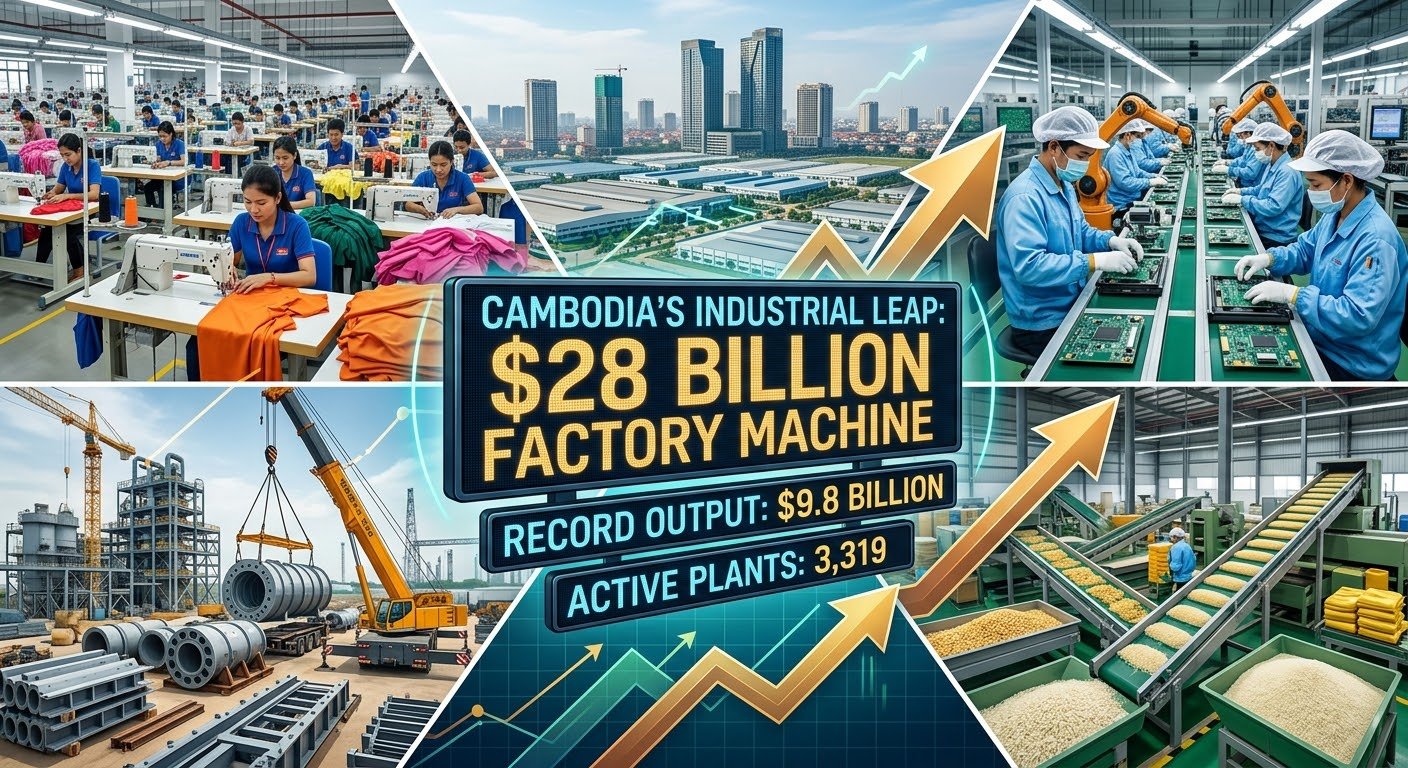
Cambodia’s industrial sector is no longer an emerging market story. It is a $28 billion manufacturing platform that is expanding at a pace few observers predicted even five years ago. Total investment in operating factories reaches approximately $28.08 billion in 2026, a surge of more than 29 percent compared with the same period in 2025. Industrial production exceeds $9.8 billion in the first six months of 2026 alone, a record figure that puts the sector on track to surpass $20 billion for the full year. The Ministry of Industry, Science, Technology and Innovation forecasts 7.1 percent industrial growth for 2026, building on 7.8 percent growth in 2025. These are not isolated data points. They represent a structural acceleration driven by foreign direct investment, government industrial policy, Special Economic Zone expansion, and the urgent need to diversify before Cambodia graduates from Least Developed Country status in December 2029. For investors, the central question is no longer whether Cambodia’s industrial base is growing. It is where the highest returns will be generated as $28 billion in deployed capital scales toward $40 billion and beyond.
The Output Engine: $9.8 Billion in Six Months
The $9.8 billion in industrial output recorded in the first half of 2026 is a headline number, but the composition tells the real story. Approximately $7.3 billion, or 74 percent, comes from garment, textile, and footwear production. This remains the backbone of Cambodia’s industrial economy, employing hundreds of thousands of workers and generating the bulk of export revenue. However, the remaining 26 percent, valued at approximately $2.5 billion, represents the fastest-growing segment of the industrial base. This non-garment output includes electronics assembly, automotive components, food and beverage processing, chemical manufacturing, furniture production, and construction materials. The growth rate in these non-garment categories significantly outpaces the traditional garment sector, driven by new factory investments in automotive, electronics, and food processing. The $9.8 billion H1 figure also implies an annualized run rate approaching $20 billion, which would represent roughly 40 percent of Cambodia’s projected 2026 GDP. This industrial intensity is comparable to Vietnam’s manufacturing sector at a similar stage of development, suggesting Cambodia is following a proven path to industrialization but at an accelerated pace.
| Category | H1 2026 Output | Share | Key Sectors |
|---|---|---|---|
| Garment/Textile/Footwear | $7.3B | 74% | Apparel, footwear, travel goods, yarns |
| Electronics and E&E | $0.6B (est.) | 6% | Wiring harnesses, circuit boards, components |
| Automotive and Parts | $0.4B (est.) | 4% | Vehicle assembly, tyres, components |
| Food and Beverage | $0.5B (est.) | 5% | Beverages, processed food, rice milling |
| Construction Materials | $0.4B (est.) | 4% | Cement, steel, glass, ceramics |
| Other Manufacturing | $0.6B (est.) | 7% | Furniture, chemicals, plastics, paper |
Factory Universe: 3,319 Large Plants + 44,381 SMEs = 1.8 Million Jobs
The sheer scale of Cambodia’s manufacturing base is often underestimated. As of June 2026, the country hosts 3,319 large-scale operating factories, an increase of 24.8 percent from the previous year. These large factories employ more than 1.3 million workers. Beyond the large-scale segment, 44,381 small and medium-sized enterprises operate in the industrial sector, employing approximately 500,000 additional workers. Together, the industrial ecosystem provides direct employment to roughly 1.8 million Cambodians, representing nearly 20 percent of the total labor force. This employment concentration makes industrial policy the single most important driver of livelihood improvement in the country. The 24.8 percent growth in large-scale factory numbers is particularly significant because it reflects new plant construction and operational expansion, not just statistical reclassification. Each new factory represents capital deployment, job creation, and supply chain development. For investors evaluating manufacturing locations, the combination of 3,319 large factories and a 1.8 million-worker industrial labor pool creates an ecosystem with established logistics, experienced management, and proven operational capabilities that newer manufacturing destinations cannot match.
| Segment | Count | Workers | YoY Growth |
|---|---|---|---|
| Large-Scale Factories | 3,319 | 1.3 million | +24.8% |
| SMEs (Industrial) | 44,381 | ~500,000 | Slight increase |
| Total Industrial Workforce | — | ~1.8 million | — |
| Total Factory Investment | — | $28.08B | +29% |
| H1 2026 Industrial Output | — | $9.8B | Record |
The Sector Boom: Automotive, Food Processing, Electronics, Chemicals, and Furniture
The most compelling aspect of Cambodia’s industrial expansion is the breadth of new investment across non-garment sectors. The Ministry of Industry confirms that investment is growing actively in automotive and auto-parts manufacturing, food processing, electronics, chemicals, furniture, and other industries. Each of these sectors addresses a distinct market opportunity. Automotive investment now totals $2.79 billion cumulatively, with 11 vehicle assembly plants producing 37,900 vehicles annually. A $450 million tyre manufacturing facility is under construction. Electronics exports surge 34 percent to $1.05 billion in the first seven months of 2026. In food processing, a $210 million cement plant expansion in Kampot province is expected to create 512 jobs, while beverage manufacturing is the most stable and advanced sub-sector within food processing. The chemicals and furniture sectors are attracting investment as both domestic construction and export demand grow. What unites these sectors is the SEZ/QIP incentive framework that offers up to nine years of tax holidays, duty-free import of raw materials and equipment, and streamlined customs procedures. For investors, the diversification across multiple sectors reduces concentration risk while providing multiple entry points into Cambodia’s industrial upgrade cycle.
Key New Factory Investments in 2026
- $210M cement plant expansion in Kampot province, 512 jobs
- $450M tyre manufacturing factory, 3,000 jobs
- TH Automotive vehicle assembly plant inauguration
- LYNK and CO assembly plant approved by CDC
- $1.1B textile FDI upstream (yarns and fabrics)
- Multiple electronics assembly facilities expanding capacity
SEZ Network: 57 Zones Form the Industrial Grid
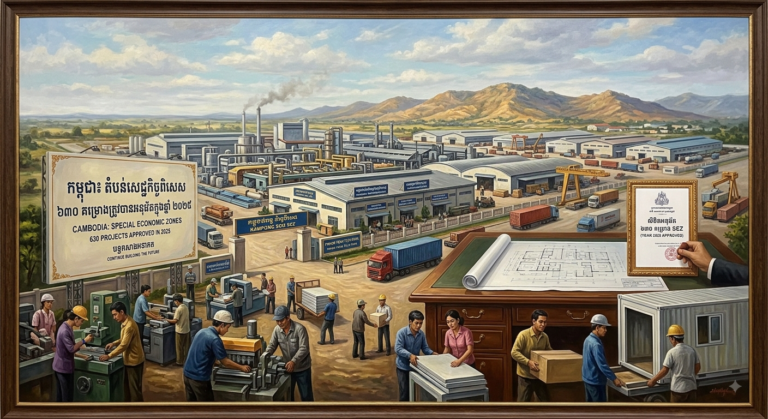
Cambodia’s Special Economic Zone network is the physical infrastructure that makes the $28 billion factory investment possible. The country now counts 57 SEZs across its territory, of which 34 are operational. Svay Rieng province leads with 12 zones, benefiting from its strategic location on the Vietnam border and the Bangkok-Ho Chi Minh City economic corridor. Kompong Cham, Kampot, Kratie, and Pursat also host active SEZs. The Manhattan Special Economic Zone in Svay Rieng, backed by Singaporean investment, stands as a showcase example of successful SEZ development. The government actively promotes new SEZ development, with Prime Minister Hun Manet confirming plans to establish additional zones in Kampot province to attract manufacturing investment. The SEZ value proposition is straightforward: world-class infrastructure, tax incentives of up to nine years, duty-free import of construction materials and production inputs, one-stop registration through the CDC, and proximity to major transport routes. For manufacturing investors, the SEZ model eliminates the infrastructure uncertainty that characterizes greenfield investments in many developing countries. The existing 34 operational zones have proven track records, established utilities, and experienced zone administrators.
The LDC Deadline: Why 2029 Is Forcing Cambodia’s Industrial Upgrade
Cambodia met the Least Developed Country graduation criteria in 2021 and 2024, entering a five-year preparatory period ahead of its scheduled transition on December 19, 2029. LDC graduation is a milestone of national development, but it also means the phased removal of preferential trade treatments that Cambodia currently enjoys, including duty-free and quota-free access to European Union markets under the Everything But Arms initiative and favorable terms under other preferential schemes. The government recognizes this challenge and is actively pushing a post-LDC economic strategy built around new trade deals, lower logistics costs, workforce upskilling, and higher-value manufacturing. The Cambodia Textile Summit 2026 highlights the urgency, with industry leaders calling for a pivot from basic cut-make-trim assembly to higher-value manufacturing that can compete without preferential tariffs. The US-Cambodia Reciprocal Trade Agreement (19 percent tariff) and RCEP provide alternative trade frameworks, but the underlying message is clear: Cambodia must move up the value chain before the preferences disappear. For investors, the LDC graduation deadline creates a time-limited window. Factories and supply chains established before 2029 benefit from the current preferential regime while building the operational capabilities needed to compete at full tariff rates after graduation.
What LDC Graduation Changes
The EU Everything But Arms initiative currently provides duty-free, quota-free access for Cambodian exports. After graduation, Cambodia transitions to standard GSP conditions, which are less generous. The US-Cambodia Reciprocal Trade Agreement (19 percent tariff) and RCEP provide alternative frameworks, but the cost differential matters. Companies that establish manufacturing in Cambodia before 2029 capture the transition period to build scale, optimize operations, and develop supplier relationships that reduce per-unit costs below the tariff disadvantage. The government is mapping a post-LDC strategy around trade deal diversification, logistics cost reduction through the Funan Techo Canal, and workforce upskilling programs.
The Poipet Risk: Border Vulnerability and Supply Chain Resilience
The recent Cambodia-Thailand border closure provides a stress test for Cambodia’s industrial resilience. Factory closures in the Poipet O’Neang Special Economic Zone have affected more than 4,000 workers, with a Thai-owned garment factory suspending operations and laying off 2,500 workers. The closures are linked to transportation disruptions and rising logistics costs caused by the border shutdown. This episode highlights a structural vulnerability: Cambodia’s industrial base, concentrated in border-adjacent SEZs that depend on cross-border supply chains, is exposed to geopolitical risks beyond its control. For investors, the Poipet situation reinforces the importance of location diversification within Cambodia. SEZs near Phnom Penh, Sihanoukville, and the Funan Techo Canal corridor offer better supply chain resilience because they access international shipping routes without depending on a single border crossing. The government’s push for new SEZs in Kampot and other provinces is partly motivated by this geographic diversification imperative. The lesson is clear: border proximity drives cost efficiency but creates concentration risk that investors must mitigate through location strategy.
Industrial Policy: High-Tech Transformation Strategy
Cambodia’s industrial policy is undergoing a fundamental shift from labor-cost arbitrage to technology-driven competitiveness. The Ministry of Industry, Science, Technology and Innovation is actively promoting a high-tech industrial transformation strategy, recognizing that the country cannot rely on low wages alone as it moves past LDC status. The Cambodia Industrial Development Conference and Expo in July 2026 featured 162 companies, including 36 from China, showcasing industrial products and technology solutions. The government is investing in technical and vocational education, digital infrastructure including 5G, and research and development capabilities. The National Strategy on Startup Development 2026-2030, launched in August 2026, adds a technology entrepreneurship dimension to the industrial policy framework. For investors, the policy direction creates opportunities in industrial technology transfer, automation and robotics for manufacturing, quality control systems, and technical training partnerships. Companies that bring technology and know-how to Cambodia’s industrial base are not just building factories. They are positioning themselves as partners in the country’s most consequential economic transformation since the garment boom of the 1990s.
Investment Playbook: Where Factory Money Is Going Next
Cambodia’s $28 billion industrial base offers four high-conviction investment opportunities for the remainder of 2026 and beyond. First, non-garment manufacturing in SEZs captures the fastest growth segment. Electronics assembly, automotive components, and food processing facilities benefit from the full QIP incentive package while serving markets that are growing faster than traditional garments. Second, upstream industrial supply chains represent a critical gap. As 3,319 large factories scale production, demand for locally sourced packaging, raw materials, and components creates opportunities for import-substitution manufacturing. Third, industrial logistics and warehousing benefit from the 29 percent investment growth as factories require increasingly sophisticated supply chain infrastructure. The Funan Techo Canal, once operational, will further reshape logistics economics. Fourth, pre-2029 LDC factory establishment captures the remaining years of preferential trade access while building the operational scale needed for post-graduation competitiveness. The risks include border disruption as demonstrated by the Poipet closures, potential tariff changes from the US reciprocal trade agreement, and the challenge of workforce upskilling as manufacturing becomes more technology-intensive. However, the structural drivers, including $28 billion of deployed capital, 1.8 million workers, 57 SEZs, and a government committed to industrial transformation, are durable. Cambodia’s factory machine is not slowing down. It is accelerating, and the investment opportunities are expanding with it.
Four High-Conviction Industrial Opportunities
- Non-Garment Manufacturing in SEZs: Electronics, auto parts, food processing. Fastest growth, full QIP incentives, 9-year tax holiday.
- Upstream Supply Chains: Packaging, raw materials, components for 3,319 factories. Import substitution, growing domestic demand.
- Industrial Logistics and Warehousing: 29% factory investment growth drives demand for storage, transport, and cold chain.
- Pre-2029 Factory Establishment: Capture remaining EBA preferences while building scale for post-graduation competition.