
Cambodia investment news & real estate market insights
Data-driven analysis of Cambodia’s investors actually need, published every week by Homvera24.
-
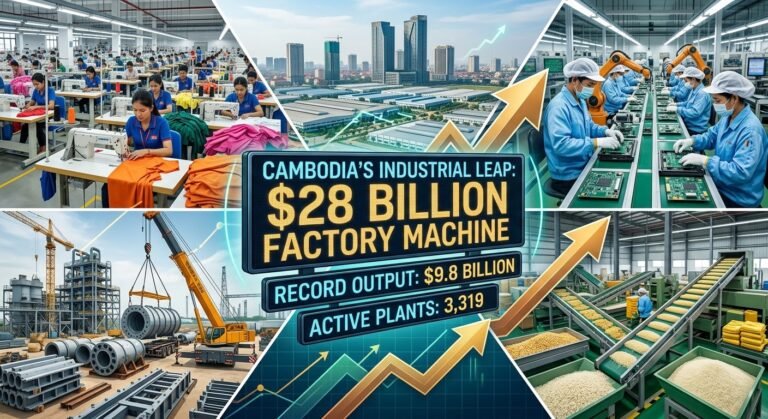
Cambodia’s $28 Billion Factory Machine: Industrial Output Hits Record $9.8B as 3,319 Plants Drive the Next Economic Leap
With 29% investment growth, 1.8 million workers, and a 2029 LDC graduation deadline, Cambodia’s industrial base is undergoing its most ambitious transformation yet $28 Billion and Counting: The Scale of Cambodia’s Industrial Machine Cambodia’s industrial sector is no longer an emerging market story. It is a $28 billion manufacturing platform that is expanding at a…
-
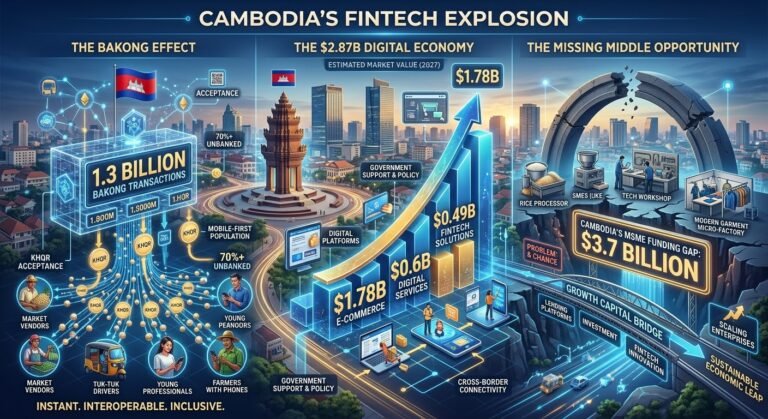
Cambodia’s Fintech Explosion: 1.3 Billion Bakong Transactions, $2.87B Digital Economy, and the Missing Middle Opportunity
How the world’s first retail DLT payment system, 70-90 fintech firms, and 5 ASEAN cross-border QR linkages are creating a once-in-a-decade investment window The Numbers That Define Cambodia’s Fintech Moment Cambodia’s fintech sector is no longer an emerging story. It is an established, data-validated investment thesis. The Bakong payment system processes 1.3 billion transactions annually….
-
Cambodia’s Great Industrial Pivot: Electronics Exports Surge 34% as Non-Garment Manufacturing Hits 62% of All Exports
How electronics, automotive assembly, and solar panel production are rewriting Cambodia’s export identity — and where $5.22 billion in FDI is flowing next The Numbers That Change Everything Cambodia’s industrial landscape is undergoing a structural transformation that is difficult to overstate. In the first seven months of 2026, the country exports electrical equipment and electronic…
-
Cambodia’s Tourism Dip Is the Smart Investor’s Best Entry Point
Arrivals are down. Revenue is up. The US is Angkor’s new #1 market. Two new airports and a 2026 tax holiday make this the window. The Counter-Intuitive Opportunity: Why a Tourism Dip Creates an Investment Window Cambodia’s tourism sector is experiencing a downturn. International arrivals fall 16.9 percent in 2025 to 5.57 million, down from…
-
Cambodia Durian Gold Rush: 5,738 Tonnes, 40x Growth, and a $7.5 Billion Market Waiting
A new rail corridor cuts transit to China from 20 days to 7. 170 farms win Chinese approval. The durian boom is real, and the investment window is open right now. The Number That Changes Everything: 5,738 Tonnes and 40x Growth 5,738 tonnes. That is the volume of fresh durian Cambodia exports to China in…
-
Cambodia’s Industrial & Logistics Real Estate Is the ASEAN Opportunity Nobody Talks About
$28 Billion in Factory Investment. 56 Special Economic Zones. A $1.7 Billion Canal. The Industrial Property Play Is Here. The Sleeping Giant of ASEAN Industrial Real Estate When investors discuss industrial real estate in Southeast Asia, the conversation revolves around Vietnam, Thailand, and Indonesia. Cambodia rarely enters the discussion. This oversight is precisely where the…




Cambodia is 100% Safe and Growing steady for investment here is common FAQ
Can foreigners buy property in Cambodia?
Yes, though the rules depend on what you’re buying. Under the 2010 Law on Foreign Ownership, a foreign national or foreign-owned company can own a condominium unit outright, as long as it’s above the ground floor and the building’s total foreign ownership stays under 70%. Landed property — houses, villas, agricultural land — can’t be owned directly by foreigners, but is commonly held through a long-term lease, a nominee structure, or a locally registered company. Cambodia’s real estate market is also fully dollar-based, which removes the currency risk that complicates property investment in many neighboring markets. We break down all three legal pathways in detail in our foreign ownership guide.
Is Cambodia a good place to invest?
The data makes a strong case for it. Cambodia approved $2.5 billion in investment capital in a single quarter of 2026 across 146 projects, and 2025 closed with 630 special economic zone projects approved and roughly $10 billion in capital committed. What’s changed is the composition of that growth: electronics and non-garment manufacturing now account for 62% of exports, agriculture is opening new export corridors like durian to China, and infrastructure spending — new airports, a $300 million World Bank-backed road program — is catching up with demand. It’s not a market without risk, and timing matters by sector, which is exactly why we publish sector-by-sector data every week rather than a single blanket recommendation.
What are Cambodia’s Special Economic Zones, and why do they matter to investors?
Special Economic Zones, or SEZs, are designated industrial areas where the Cambodian government offers streamlined customs procedures, tax holidays, and pre-approved infrastructure to attract manufacturing investment. The Council for the Development of Cambodia approved 630 SEZ projects in 2025 alone, representing roughly $10 billion in capital and 438,000 new jobs — the strongest year on record. For investors, SEZs matter because they concentrate risk reduction in one place: land use is pre-cleared, utilities are already run, and the regulatory approval process is faster than setting up outside a zone. The trade-off is that not all zones are equal — location relative to ports, labor availability, and sector focus vary widely, which is why we track zone-level data rather than treating the SEZ program as a single monolithic opportunity.
What is Cambodia’s ‘Pentagonal Strategy,’ and how does it affect investors?
The Pentagonal Strategy is the current government’s development framework under Prime Minister Hun Manet, built around five priority pillars: human capital development, economic diversification, private sector and job growth, resilience, and sustainable development. For investors, the practical effect is visible in where capital and infrastructure spending have concentrated since 2023 — special economic zone expansion, non-garment manufacturing incentives, and agricultural financing programs, including a $100 million initiative to stabilize rice prices for farmers. Whether a framework like this translates into faster approvals or better returns depends on the sector, which is why we track the underlying numbers — SEZ approvals, FDI figures, export data — rather than the strategy documents themselves.
Has Cambodia’s investment policy stayed consistent through the transition from former PM Hun Sen to PM Hun Manet?
Broadly, yes. former PM Hun Sen led Cambodia for nearly four decades and built the current pro-FDI framework — dollarization, garment-sector export incentives, and the original special economic zone system. Hun Manet, who took office in August 2023 in a planned transition rather than an election upset, has continued that orientation while shifting emphasis toward diversifying away from garment manufacturing and toward electronics, agriculture exports, and infrastructure. The continuity matters for investors more than any single leader’s rhetoric: the legal structures foreign investors rely on — the 2010 Foreign Ownership Law, the CDC’s investment approval process — predate this transition and have remained stable through it, which is part of why capital approvals have kept climbing rather than pausing during the change in leadership.
Where can I find independent analysis of Cambodia’s government and investment climate, not just official statements?
This is worth doing before committing capital anywhere, and Cambodia is no exception. Government and CDC figures are useful for tracking approved capital and project counts, but investors should also weigh independent sources: multilateral assessments from the World Bank and IMF on macroeconomic conditions, credit rating agency reports for sovereign and sector risk, and governance and press-freedom assessments from organizations like Freedom House or Human Rights Watch, since political and regulatory risk are part of any serious due-diligence process. We publish the economic data as it’s reported by official and multilateral sources, but we’d encourage any investor to triangulate across sources rather than rely on a single narrative — ours included.