
How Foreigners Buy Property in Cambodia: The Complete Legal Playbook
Three Legal Pathways, One Dollar-Based Market, Zero Currency Risk. Here Is Exactly How It Works.
The Most Important Number: 70 Percent
Seventy percent. That is the maximum share of a condominium building that foreigners can own in Cambodia. Under the 2010 Law on Foreign Ownership, any foreign national or foreign-owned company can purchase private units in a registered co-owned building, in their own name, with a strata title. The building must be at least one floor above ground level. Ground-floor units and underground parking remain reserved for Cambodian citizens.
This 70 percent rule is generous by regional standards. In Thailand, foreigners face similar condo ownership rules but face more restrictive lease structures for land. In the Philippines, foreigners can only own condo units in buildings where at least 60 percent of the units are owned by Filipinos. In Indonesia, foreign ownership is limited to apartments above a certain price floor, and the rules change frequently. Cambodia offers a straightforward, stable framework that has been in place since 2010.
What does strata title actually mean? It means your name appears on the title deed. Not a company name. Not a nominee name. Your name, as a foreigner, registered at the Ministry of Land Management. This is the strongest form of property ownership available to non-Cambodians. You can sell, mortgage, or transfer the unit without additional approval. You receive the proceeds directly. The title is real, enforceable, and recognized under Cambodian law.
The Three Legal Pathways for Foreign Buyers
Foreigners have three distinct legal pathways to own or control real estate in Cambodia. Each pathway serves a different investment strategy. Understanding all three is essential before you deploy capital.
| Pathway | What You Can Own | Ownership Type | Best For |
|---|---|---|---|
| Strata Title (2010 Law) | Condo units above ground floor | Freehold in your name | Apartments, rental yield |
| Trust Law (2019 Law) | Land, houses, shophouses, any property | Beneficial ownership via trustee | Land banking, development |
| Long-Term Lease | Any immovable property | 50-year lease, renewable | Industrial land, commercial |
Each pathway has different costs, risks, and levels of legal protection. For most foreign investors, the strata title route is the simplest and safest starting point. The trust law route opens up land and landed property, which strata title cannot reach. The long-term lease is a practical option for industrial or commercial investments where you need land access but do not require freehold.
Strata Title: The Direct Route to Condo Ownership
Strata title ownership is the most popular and most straightforward path for foreign buyers. You identify a condominium project registered under the 2010 Co-ownership Law. You select a unit on the first floor or above. You sign a sale and purchase agreement. You pay a 4 percent transfer tax. You receive a strata title in your own name at the Ministry of Land Management. The entire process typically takes four to six weeks with legal assistance.
The practical details matter. Entry-level condos in outer districts of Phnom Penh start at around $50,000 to $80,000 for a studio or one-bedroom unit. Mid-market units in areas like Toul Kork cost approximately $1,800 per square meter. Premium units in BKK1, Tonle Bassac, and Diamond Island range from $3,000 to $4,500 per square meter. A central Phnom Penh condo at $1,500 to $2,500 per square meter is materially cheaper than equivalent locations in Bangkok, Ho Chi Minh City, or Manila.
Rental yields make the investment case compelling. Gross rental yields for condominiums in Phnom Penh range from 4.9 percent to over 8 percent depending on location and property type. The city-wide average is approximately 7 percent. In prime areas like BKK1, yields can reach 8.5 percent. Year-on-year rent growth is projected at 1 to 3 percent nationwide in 2026, with prime areas recording stronger gains. For a dollar-based investor, these yields are paid in US dollars, which eliminates currency risk entirely.
Trust Law: The Game-Changer for Land Ownership
Cambodia’s Trust Law, enacted in 2019, is the single most important legal development for foreign property investors in the country’s modern history. Before this law, foreigners who wanted to own land had to rely on informal nominee structures with significant legal risk. The nominee is the legal owner. If the nominee sells, mortgages, or disputes the property, the foreign investor faces complex legal battles with uncertain outcomes.
The Trust Law changes this equation entirely. Under this framework, a foreign investor appoints a licensed trust company to hold legal title to the property. The investor retains beneficial ownership and full economic control. The trust company manages the property according to the terms of the trust agreement. The investor receives rental income, sale proceeds, and all economic benefits. The trust company cannot sell, mortgage, or transfer the property without the investor’s instruction.
This structure is unique in Southeast Asia. No other country in the region offers a government-regulated trust framework specifically designed for foreign property ownership. The Cambodian government reports that the Trust Law is securing significant foreign investment, with the framework attracting growing interest from investors in Singapore, China, Japan, and Western markets. For investors who want to own land, build houses, develop shophouses, or acquire agricultural property, the Trust Law provides a legal, regulated pathway that simply does not exist in most competing markets.
Long-Term Lease: The Flexible Alternative
The third pathway is a registered long-term lease. Cambodian law allows foreigners to sign lease agreements of up to 50 years, with an option to renew for an additional 50 years. The lease is registered with the Ministry of Land Management, which gives it legal weight and enforceability. The lessee has full rights to use, develop, sublease, or mortgage the property during the lease period.
This structure is particularly useful for industrial and commercial investments. A manufacturing company that needs land for a factory but cannot use strata title or does not want the complexity of a trust structure can secure a 50-year registered lease. A hospitality investor building a resort on coastal land can use the same structure. The 100-year combined lease term provides sufficient time for most commercial investments to generate strong returns.
The key distinction between a registered long-term lease and an informal lease is the registration. An unregistered lease is only as strong as the landlord’s willingness to honor it. A lease registered with the Ministry of Land Management creates a legally recognized interest in the property. This means the lease survives a change in property ownership. If the landlord sells the land, the new owner is bound by the existing lease. For investors, this protection is essential.
The Tax Picture: What It Actually Costs
Understanding the full tax picture is critical before you buy. Cambodia’s property tax system is straightforward, but recent changes to capital gains tax require attention. Here is the complete breakdown:
| Tax | Rate | Details |
|---|---|---|
| Transfer Tax (Stamp Duty) | 4% | Paid by buyer on the property transfer price. Applies to all transactions. |
| Property Tax | 0.1% | Annual tax on property value above $25,000. Below that, exempt. |
| Capital Gains Tax | 20% | On net gain from sale. Primary residences held 5+ years may be exempt. |
| Rental Income Tax | 10% | Flat rate on rental income for non-resident foreign landlords. |
| No Annual Tax | N/A | Owner-occupied residences under $25,000 pay zero annual property tax. |
The capital gains tax, implemented in September 2025, is the newest element. It applies at a flat rate of 20 percent on the net gain from the sale of immovable property. The net gain is calculated as the sale price minus allowable deductions, which include the original purchase price, transfer taxes, and improvement costs. Taxpayers can also choose a depreciation-based calculation method. Importantly, primary residences owned for five years or more may qualify for exemption.
The 4 percent transfer tax is your main transaction cost. On a $100,000 condo purchase, you pay $4,000 in transfer tax. This is competitive with the region. Thailand charges similar transfer fees. Vietnam’s transfer taxes can be higher depending on the structure. The ongoing property tax at 0.1 percent is among the lowest in Southeast Asia. For a $150,000 condo, your annual property tax is approximately $125. This is a negligible holding cost relative to the rental income.
Residency by Investment: CM2H and the ER Visa
Cambodia offers two residency programs relevant to property investors. The first is the ER Visa, initially issued for one year and indefinitely renewable. There is no minimum investment amount tied to the ER Visa. You simply apply, meet basic requirements, and receive a renewable residence permit. This is one of the easiest residency programs in Asia.
The second, and more significant, program is Cambodia My Second Home, or CM2H. This residency-by-investment program requires a minimum investment of $100,000 in approved real estate or an equivalent bank deposit. In return, you receive a 10-year visa with work rights and a Cambodian ID card. There is no minimum stay requirement. After five years, the program can lead to citizenship eligibility. This makes CM2H one of the most attractive residency-by-investment programs in Southeast Asia, particularly when you consider that the $100,000 investment is in a dollar-based asset generating rental yield.
The practical implication is powerful. You invest $100,000 in a Phnom Penh condominium that generates 7 percent gross yield, or approximately $7,000 per year in rental income. You receive a 10-year residency visa with work rights. Your investment is in US dollars, so there is no currency depreciation risk. You can visit Cambodia anytime, work there, and after five years, pursue citizenship. The investment pays for itself while providing residency benefits.
Hard Title vs. Soft Title: Why the Difference Matters
Cambodia has two types of land titles. A hard title, formally known as a Certificate of Immovable Property Ownership, or CIPO, is registered at the national level with the Ministry of Land Management. It is the gold standard of Cambodian land ownership. A hard title is guaranteed by the state, enforceable in court, and recognized by all banks. You can mortgage a hard title property to secure financing.
A soft title is registered at the local level, typically with the commune or district office. It provides partial property rights but lacks the full legal protection of a hard title. Soft titles are more common in rural areas and for older properties. The risk is that they are vulnerable to competing claims. If two parties hold soft titles for the same property, resolving the dispute is complex and uncertain.
For foreign buyers, this distinction matters because strata titles are derived from hard titles. The building must have a hard title for the strata titles to be valid. Always verify that the building has a proper hard title and that the strata title registration is complete at the Ministry of Land Management. The Cambodian government is conducting a nationwide land registration program with the goal of completing all registrations by 2027, converting soft titles to hard titles across the country.
Step-by-Step: How to Buy a Condo as a Foreigner
The buying process is simpler than many investors expect. Here is the practical sequence:
Step 1: Choose the right property type. Decide whether a condo, landed property, commercial space, or industrial land best fits your goals. Condos offer the simplest path through strata title. Landed property requires the Trust Law or a long-term lease.
Step 2: Verify ownership and legal status. Conduct a title search at the Ministry of Land Management. Confirm the property has a hard title. Check for existing mortgages, liens, or disputes. Verify the building is registered under the 2010 Co-ownership Law.
Step 3: Choose your ownership structure. Strata title for condos. Trust Law for land and houses. Long-term lease for commercial or industrial use. Each structure has different costs and legal requirements.
Step 4: Secure financing if needed. Cambodian banks offer mortgage lending to foreign buyers. Interest rates are typically 7 to 9 percent. Loan-to- value ratios range from 50 to 70 percent.
Step 5: Sign the sale and purchase agreement. This binding contract specifies the purchase price, payment terms, completion timeline, and any conditions. Have your lawyer review this document before signing.
Step 6: Complete the transfer. The transfer takes place at the Ministry of Land Management. The 4 percent transfer tax is paid at this stage. The new title is issued in the buyer name. For strata title condos, this process takes approximately four to six weeks from signing to title issuance.
The Dollar Advantage That Changes Everything
Here is the factor that makes Cambodia fundamentally different from every other property market in Southeast Asia. Cambodia operates on the US dollar. This is not a partial arrangement or a pegged currency. The US dollar is the dominant currency for real estate transactions, rental payments, and property valuation.
What does this mean for you? When you buy a $150,000 condo in Phnom Penh, you price it, pay for it, and collect rent in US dollars. There is no currency conversion when you repatriate rental income. There is no hedging cost. There is no risk that local currency depreciation erodes your returns. The Cambodian riel trades at approximately 4,044 KHR per USD and has depreciated by only 0.53 percent over the past year.
Compare this to Vietnam, where the dong depreciates by 2 to 4 percent per year against the dollar. Or to Thailand, where the baht fluctuates with central bank policy. In Cambodia, your rental yield is your actual yield, not a nominal number that currency depreciation silently reduces. For global investors allocating capital across multiple markets, this eliminates an entire category of risk.
Risks and How to Manage Them
Every property market carries risk. Cambodia is no exception. The smart approach is to identify the specific risks and develop practical strategies to manage them.
Title disputes. Cambodia’s land title system is improving but still evolving. Only buy properties with hard titles registered at the national level. Verify the title at the Ministry of Land Management. Use a licensed Cambodian property lawyer for every transaction.
Market illiquidity. Cambodian real estate is less liquid than property markets in Singapore or Hong Kong. Selling a property can take months. Treat your Cambodia property as a medium to long-term investment. Buy for yield and appreciation over a five to ten-year horizon. The dollar-denominated yields support a hold strategy.
Trust Law complexity. The framework is still relatively new. Work only with licensed trust companies that have a proven track record. Have your independent lawyer review the trust agreement before you sign.
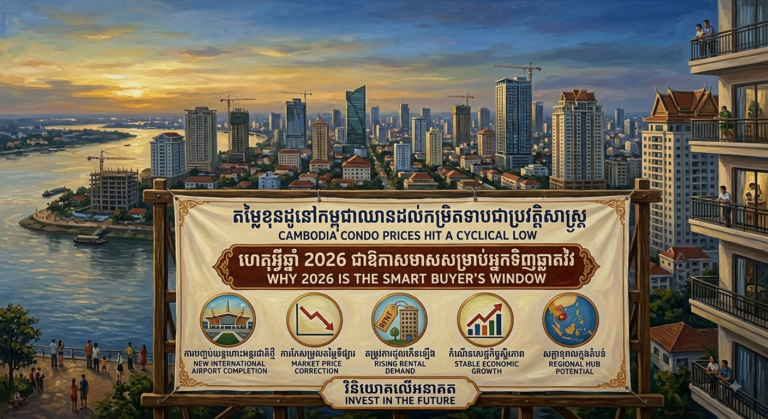
Price correction. Phnom Penh condo prices have declined by approximately 8 percent in 2025-2026. For buyers entering now, this is an advantage. Lower entry prices mean higher starting yields. The market is expected to stabilize and recover by 2027, supported by economic growth and the CM2H residency program.
Your Next Step
Cambodia offers foreign investors a property ownership framework that is among the most accessible in Southeast Asia. Strata title gives you freehold condo ownership in your own name. The Trust Law opens land and landed property to foreign ownership through a regulated structure. Long-term leases provide 100-year combined terms for commercial and industrial use. The entire market operates in US dollars, eliminating currency risk. The CM2H program turns a $100,000 property investment into a 10-year residency visa.
If you are a first-time buyer, start with a strata title condo in a prime location like BKK1, Toul Kork, or Chroy Changvar. These areas offer yields of 5 to 8 percent, strong rental demand, and the most liquid resale market. If you are an experienced investor looking for land, engage a licensed trust company and a qualified property lawyer to structure your purchase under the Trust Law.
The legal pathways are clear. The yields are real. The currency is yours. Cambodia is open for property investment, and the entry prices right now are the most favorable they have been in years. The question is not whether to invest. The question is which pathway fits your strategy.