
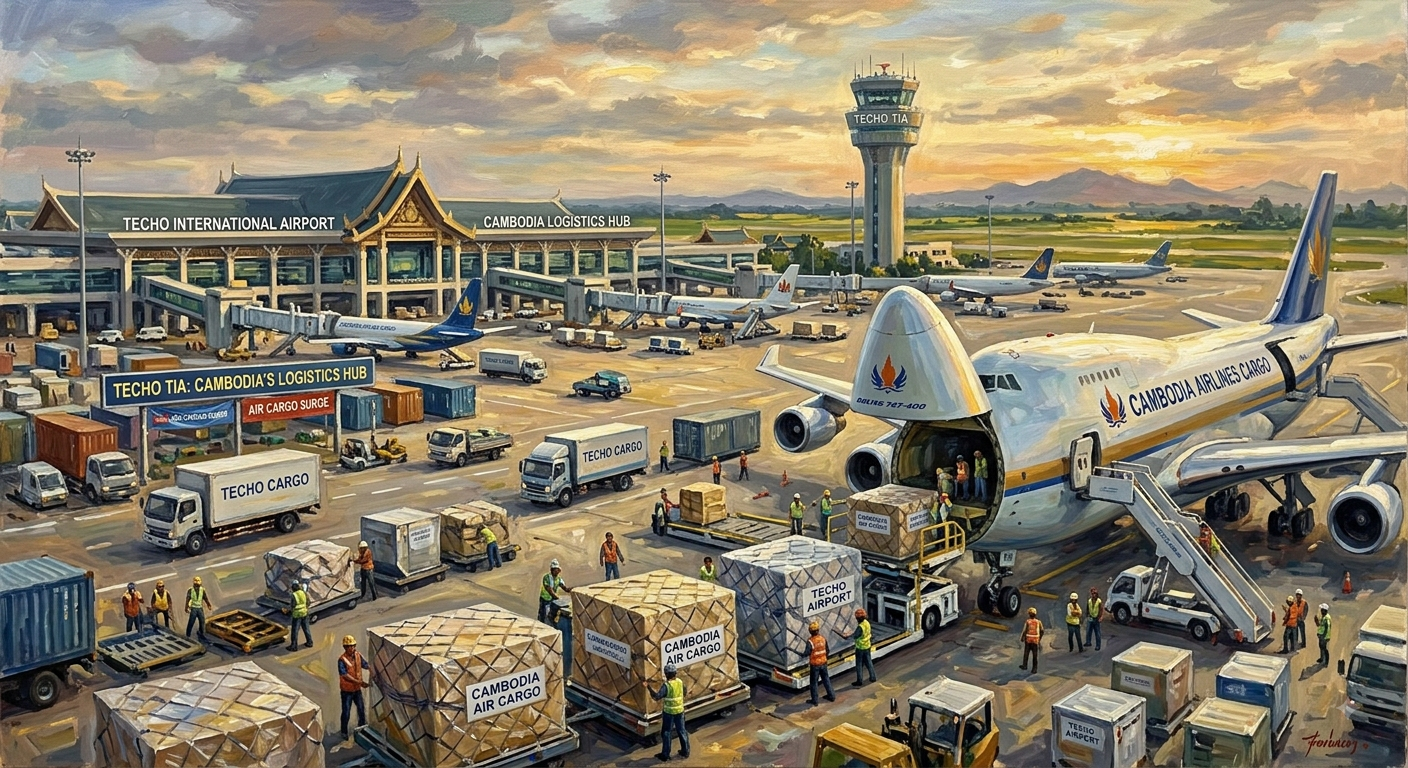
Cambodia’s Air Cargo Surges 29%: Techo Airport Is Turning the Country Into a Regional Logistics Hub
Cambodia is moving serious freight through the sky. In the first half of 2026, the country handles 47,627 tonnes of air cargo, a 29% surge compared to the same period in 2025. In the first four months alone, volumes jump 36% to hit 30,448 tonnes. These are not gradual improvements. This is a structural shift in how goods move in and out of Cambodia. The driver behind this surge is Techo International Airport, the $2 billion facility that opens in September 2025 and immediately changes the logistics equation for the entire country. For investors, this air cargo boom signals a clear opportunity in logistics infrastructure, cold chain facilities, and export-oriented manufacturing.
Every data point in this article comes from verified public sources including the State Secretariat of Civil Aviation, the Cambodia Airports operator, EuroCham, the CDC, the Kiripost, and the Delphos analysis platform.
Techo International Airport: A $2 Billion Game Changer
Techo International Airport is not just a new airport. It is a complete reset of Cambodia’s aviation and logistics capacity. The facility sits 19 kilometers south of Phnom Penh on a 700-hectare site. It is a 4F-class airport, which means it handles the largest commercial aircraft in the world including long-haul freighters. Phase 1, which is now operational, gives the airport the capacity to process 13 to 15 million passengers and 175,000 tonnes of cargo per year. Phase 2, planned for completion by 2030, expands capacity even further.
Before Techo, Cambodia relies on the old Phnom Penh International Airport. That facility handles 57,102 tonnes of cargo in all of 2025 with a 21% year-on-year increase. In just the first six months of 2026, the new airport already moves 47,627 tonnes. At this pace, Cambodia is on track to exceed 95,000 tonnes for the full year. The 2026 target set by the State Secretariat of Civil Aviation is 112,000 tonnes. The gap between current performance and the target represents the growth runway still ahead.
The airport is not just bigger. It is designed for efficiency. Dedicated cargo terminals, modern warehousing, streamlined customs processing, and direct highway connections to Phnom Penh and the Special Economic Zones make Techo a logistics platform, not just a passenger terminal. Cambodia Airports, the state-owned operator, actively promotes logistics expansion as a core part of its business strategy.
The Numbers Behind the Cargo Surge
The scale of the air cargo growth is remarkable when you look at the monthly and annual data. Cambodia’s total merchandise exports reach more than $17 billion in the first half of 2026, a 19.5% year-on-year increase. Imports grow 21.4% to $19.7 billion. Total trade for H1 2026 exceeds $36.7 billion. Exports to the United States alone hit $3.35 billion in Q1 2026, a 38.4% increase. These goods need to move. Air cargo is the fastest way to move high-value, time-sensitive products like electronics components, garment samples, pharmaceutical products, and fresh agricultural produce.
The 29% cargo surge in H1 2026 is especially striking because it happens alongside a 7% decline in passenger traffic at Techo International Airport. This divergence tells an important story. The cargo growth is not a side effect of more passengers checking bags. It is a standalone logistics phenomenon driven by real trade demand. Businesses are choosing Cambodia as a freight origin and destination point. The aviation sector is split, and the freight side is winning.
| Indicator | Value | Source |
|---|---|---|
| Air Cargo H1 2026 | 47,627 tonnes | SSCA, Jul 2026 |
| Air Cargo Growth (H1) | +29% YoY | SSCA, Jul 2026 |
| Air Cargo Jan-Apr 2026 | 30,448 tonnes | Kiripost, May 2026 |
| Air Cargo Growth (Jan-Apr) | +36% YoY | Kiripost, May 2026 |
| Full Year 2025 Cargo | 57,102 tonnes | SSCA |
| 2026 Cargo Target | 112,000 tonnes | SSCA |
| 2026 Passenger Target | 8 million | SSCA |
| Techo Phase 1 Cargo Capacity | 175,000 tonnes/year | EuroCham |
| Techo Phase 1 Passenger Capacity | 13-15 million/year | Cambodia Airports |
| H1 2026 Exports | $17 billion (+19.5%) | SSCA / VICO Logistics |
| Q1 2026 Exports to US | $3.35 billion (+38.4%) | Trade Data |
Source: SSCA, Kiripost, EuroCham, Cambodia Airports, VICO Logistics (2025-2026)
Why Air Cargo Is Surging: The Forces Behind the Numbers
Three forces drive Cambodia’s air cargo expansion. Each force creates a different set of investment opportunities.
First, global supply chain redirection. The trade landscape in 2026 is in flux. Tariff structures between the US, China, India, Vietnam, and other major economies are shifting. The Cambodia-US Reciprocal Trade Agreement, signed in October 2025, eliminates tariffs on 100% of US products exported to Cambodia. In return, the US maintains reciprocal tariff rates. This agreement, combined with tariff uncertainty affecting other ASEAN manufacturing hubs, makes Cambodia an attractive alternative for supply chain diversification. Delphos analysis specifically identifies Cambodia’s air cargo infrastructure as a key factor in this redirection. Companies that previously route goods through India or Vietnam are now looking at Cambodia as a viable alternative.
Second, the export boom in high-value goods. Cambodia’s garment sector remains the largest export category, but electronics, automotive parts, and agricultural products are growing fast. Electronics components, semiconductor packaging, and e-bike assembly are moving into Cambodia’s Special Economic Zones. These products require air freight for speed and reliability. Fresh agricultural exports like mangoes, longans, and bananas also benefit from air cargo to reach markets in China, South Korea, and the Middle East before spoilage. Cambodia’s industrial production jumps 63% in 2026, and a significant portion of that output is air-freight eligible.
Third, infrastructure readiness. Techo Airport’s Phase 1 cargo capacity of 175,000 tonnes per year is vastly larger than current demand. This means the airport has room to absorb significant growth without congestion or delays. The highway connection from Techo to Phnom Penh and onward to the major SEZ corridors makes the logistics chain seamless. The government’s National Policy on Air Transport 2025-2035 provides a long-term framework for continued aviation investment. Sihanoukville Airport is also undergoing rehabilitation and extension. A new $1.5 billion airport in Siem Reap is under development by a Chinese state consortium. Cambodia is building a multi-airport logistics network, not just a single facility.
The Investment Opportunity: Where Smart Money Is Going
For investors, Cambodia’s air cargo surge creates opportunities across several sectors. The key is to understand which parts of the logistics chain are underserved and where demand is growing fastest.
Cold chain logistics is the first major gap. Cambodia’s agricultural exports are booming, but cold chain infrastructure remains limited. Fresh fruits, vegetables, seafood, and pharmaceutical products require temperature-controlled storage and transport from farm to airport to destination. The IFAD estimates that Cambodia needs an additional $250 million per year in food logistics infrastructure, with a focus on reducing post-harvest losses for perishable goods. An investor who builds cold chain warehousing near Techo Airport, with direct access to the cargo terminal, captures a growing and underserved market. The demand is clear. The supply of facilities is not.
Cargo warehousing and freight forwarding is the second opportunity. As air cargo volumes grow from 57,000 tonnes in 2025 toward the 112,000-tonne target, the need for modern warehousing, consolidation services, customs brokerage, and last-mile delivery networks grows with it. Most of Cambodia’s current logistics providers are small and fragmented. A well-capitalized logistics company that builds modern bonded warehousing near Techo, invests in digital tracking systems, and partners with international freight networks has a first-mover advantage in a market that is doubling in size.
Airport-adjacent manufacturing is the third play. The SEZs expand to 65 zones across Cambodia. The government pushes for higher-value manufacturing in electronics, automotive parts, and food processing. These industries benefit directly from proximity to an international air cargo hub. An electronics assembly plant or a food processing facility located within a 30-minute drive of Techo Airport has a genuine logistical advantage over competitors in other ASEAN countries who must truck goods to distant airports. The CDC offers tax incentives of up to nine years for qualifying investment projects in or near SEZs. Combined with the logistics advantage of Techo, this creates a compelling investment case.
Government and Institutional Support
Cambodia’s government and its institutional partners are actively supporting the logistics sector. The State Secretariat of Civil Aviation sets the 8 million passenger and 112,000 tonne cargo targets for 2026 under the National Policy on Air Transport 2025-2035. This policy framework provides certainty for long-term investors. The CDC and EuroCham convene high-level conferences to advance dialogue on trade facilitation, port efficiency, customs modernization, and air cargo development. The World Bank commits $150 million to transport corridor upgrades along the Asian Highway 21, which feeds directly into the airport logistics chain.
The Cambodia Airports operator, which manages Techo, is state-owned and actively seeking logistics partners. The government recognizes that airport infrastructure alone is not enough. The ecosystem of warehousing, cold chain, freight forwarding, and digital logistics platforms needs private investment to reach its full potential. This is where the CDC’s investment incentive framework connects with the aviation sector. A logistics company that establishes operations near Techo can qualify for the same tax holidays, import duty exemptions, and VAT exemptions available to manufacturing investors in SEZs.
The Bigger Picture: Cambodia’s Logistics Transformation
Techo Airport is one piece of a much larger logistics transformation underway in Cambodia. The Funan Techo Canal, a $1.7 billion megaproject, is under construction to connect Phnom Penh to the Gulf of Thailand via a 180-kilometer waterway. This canal will accommodate vessels up to 3,000 DWT and reduce Cambodia’s dependence on ports in neighboring countries. The World Bank’s $150 million investment in the Asian Highway 21 corridor improves road freight connectivity. Sihanoukville’s deep-water port continues to expand. A third port is in planning stages.
What emerges is a multi-modal logistics network: air freight through Techo, sea freight through Sihanoukville and the new canal, road freight through upgraded highway corridors, and digital payments through the Bakong system. For logistics investors, this is not a bet on a single airport. It is a bet on an entire country building the transport infrastructure of a middle-income economy. The air cargo surge is the most visible signal of this transformation, but it is not the only one.
What This Means for You as an Investor
Cambodia’s air cargo is growing at nearly 30% per year. The new Techo International Airport has five times the cargo capacity the country currently uses. Export volumes are surging. Global supply chains are redirecting toward Cambodia. The government is actively seeking private logistics investment and offering competitive incentives. Cold chain infrastructure, modern warehousing, and airport-adjacent manufacturing represent specific, actionable opportunities with clear demand drivers.
If you are an investor looking at Southeast Asia’s logistics sector, Cambodia offers something that more established markets do not: rapid growth from a low base, modern new infrastructure, strong government support, and a first-mover advantage in many sub-sectors. The air cargo numbers tell the story. The question is whether you position yourself ahead of the growth curve or watch from the sidelines.
Disclaimer: This article is for informational purposes only and does not constitute financial advice. All data is sourced from public authorities and verified news outlets. Investors should conduct their own due diligence before making any investment decisions.