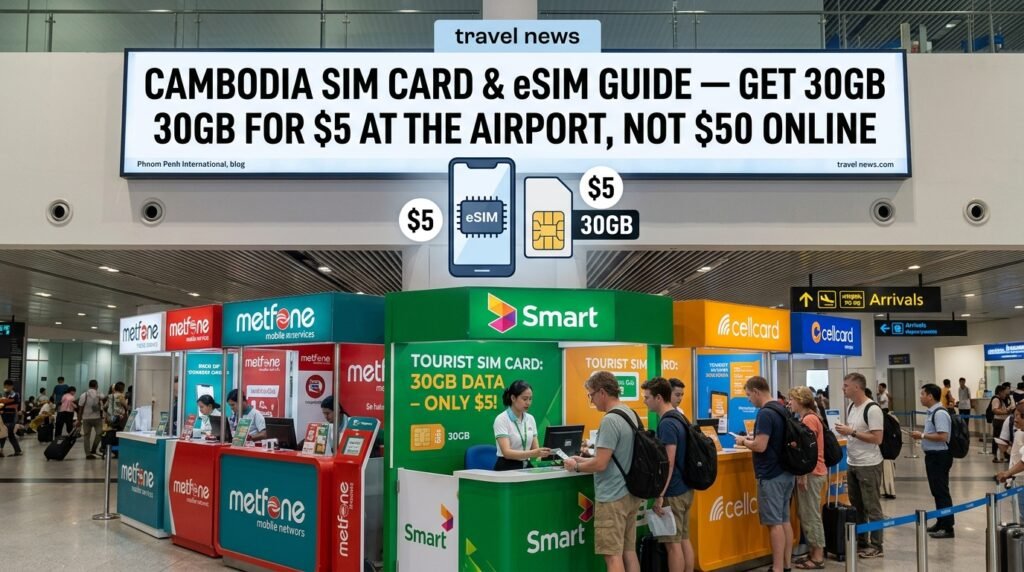
Most travelers buy a $50 travel eSIM before they fly. The same data costs $5 at Phnom Penh airport. This 2026 insider guide covers Cellcard, Smart, and Metfone plans, the airport kiosks that are safe, the ones that scam you, and the exact steps to activate in under 5 minutes.
Almost every traveler arriving in Cambodia makes the same mistake. They buy a travel eSIM online before they fly. They pay $25, $40, sometimes $60 for 5GB to 10GB of data. They feel smart because they avoid roaming charges. Then they land at Techo International Airport in Phnom Penh, walk past three telecom kiosks, and discover the same data costs $5 to $10. The look on their face says everything.
This guide exists because most online Cambodia SIM guides are outdated, vague, or written by affiliate marketers who never set foot in the country. We pull current 2025–2026 plan prices straight from the carrier websites, the airport kiosk reviews, and recent traveler reports from forums and Reddit. The goal is simple — show you exactly what to buy, where to buy it, and how to avoid the scams that target first-time visitors.
INSIDER TAKEAWAY
Buy a local SIM at the airport, not online. Cellcard and Smart both sell tourist plans under $10 with 25–35GB of data, valid for 15–30 days. The kiosk staff register and activate the SIM on the spot with your passport. You walk out of the airport connected in under 5 minutes for less than the cost of a Phnom Penh dinner.
The Big Three Carriers — Cellcard, Smart, Metfone
Cambodia has three main mobile networks. All three cover the major tourist areas well, but they differ in price, data allowance, and coverage in remote provinces. The right choice depends on where you travel and how much data you use.
Cellcard runs on a 4G and 5G network and offers the best value tourist plans in 2026. A standard Cellcard tourist SIM costs about $5.50 to $8.50 for 3GB to 5GB valid for 7 days. The bigger value comes from the regular prepaid plans — $5 gets you 25GB for 28 days, and $5 gets you 40GB for 30 days, with unlimited on-net calls and texts. Cellcard is the choice for travelers who plan to use a lot of data, post on social media, and stream video.
Smart Axiata is the second option. Smart sells a dedicated Smart Traveller SIM at every international airport kiosk in Cambodia. The plans include 300 on-net call minutes. Smart also offers a $10 plan with 60GB of data at standard rates, and a $6 plan with 21GB valid for 7 days. Smart’s network reaches all major cities and tourist hubs. The Smart eSIM is also available, which matters if your phone no longer has a physical SIM slot.
Metfone runs the widest coverage network in Cambodia, including remote provinces. If your trip goes beyond the standard Phnom Penh–Siem Reap–Sihanoukville triangle — for example, to Mondulkiri, Ratanakiri, or the Cardamom Mountains — Metfone is the safest choice. Tourist plans start around $3 for short visits. Metfone officially serves tourists at airport kiosks, official telecom stores, and authorized retailers. Staff help with registration and activation.
QUICK FACTS — CAMBODIA SIM CARDS 2026
| Main carriers | Cellcard, Smart Axiata, Metfone |
| Cheapest tourist SIM | From $3 (short plans) · $5 for 25–40GB (30-day) |
| eSIM available | Yes — Smart and Cellcard |
| Network speed | 4G LTE nationwide, 5G in Phnom Penh |
| Activation time | 2 to 5 minutes at airport kiosk |
| Passport required | Yes — mandatory for registration |
| Top-up methods | Carrier app, scratch cards, convenience stores |
Plan Comparison — What $5, $10, and $15 Actually Buys
Carrier plans change often. The table below shows current 2026 prices from official carrier sites and recent traveler reports. Prices may shift slightly, but the structure stays stable.
| CARRIER | PLAN | DATA | VALIDITY | PRICE (USD) |
|---|---|---|---|---|
| Cellcard | Tourist SIM | 3GB | 7 days | $5.50 |
| Cellcard | Prepaid | 25GB | 28 days | $5 |
| Cellcard | Prepaid | 40GB | 30 days | $5 |
| Smart | Traveller SIM | 21GB | 7 days | $6 |
| Smart | Traveller SIM | 60GB | 30 days | $10 |
| Metfone | Tourist | 3-day plan | 3 days | $3 |
| Metfone | Tourist | Extended | 7–15 days | $5 |
The pattern is clear. Cellcard wins on data per dollar for longer stays. Smart wins on convenience at the airport because of its dedicated Traveller SIM kiosk at every international airport. Metfone wins for travelers heading to remote provinces. Most short-stay tourists pick Cellcard or Smart and stay happy.
Where to Buy at Techo International Airport
Techo International Airport opened in September 2025 as the new gateway to Phnom Penh. It replaced the old Phnom Penh International Airport. After you clear immigration and collect your bags, you walk through the arrivals hall. The telecom kiosks sit in a row before the exit doors. You see three names — Cellcard, Smart, and Metfone — sometimes alongside a smaller Yes Seatel kiosk.
The official Smart kiosk is the easiest to find. Smart runs a dedicated Traveller SIM booth at every international airport in Cambodia, and staff speak English. The Cellcard kiosk sits inside the airport after immigration. Metfone staff at the airport kiosk can help with registration and activation on the spot. The key is to walk to the official carrier kiosk, not the small “SIM card” stalls run by third-party resellers.
At Siem Reap International Airport, the same three carriers run kiosks in the arrivals area. The prices match Phnom Penh. At Sihanoukville International Airport, you find Cellcard and Smart kiosks but fewer Metfone options.
WATCH OUT
Some travelers report scams at smaller airport kiosks. A tout sells a SIM card at 5 to 10 times the official price, skips passport registration, and gives no receipt. The SIM either fails to activate, stops working after a few days, or links to a stranger’s identity. Walk only to the official carrier kiosk with the brand logo. Ask for a printed or SMS receipt. The official kiosk never charges more than the listed plan price.
How to Activate a Physical SIM — Step by Step
The activation process at the airport kiosk takes 2 to 5 minutes. Here is exactly what happens.
- Hand over your passport. Cambodia law requires every SIM card to link to a passport. The kiosk staff photocopies the photo page or scans it into the carrier system.
- Pick your plan. Tell the staff how many days you stay and how much data you want. They suggest the cheapest plan that fits. For most travelers, the $5 to $10 plan covers a 7 to 14 day trip.
- Pay in USD cash. Kiosks take US dollars, Cambodian riel, and sometimes QR payment through Bakong Tourists. Carry small bills.
- Insert the SIM. Staff insert the SIM into your phone for you if you ask. They also help switch your phone to the new network if needed.
- Wait for activation. The SIM activates in 1 to 5 minutes. You receive a welcome SMS with your new Cambodian phone number, the data balance, and the plan expiry date.
- Test the data. Open a website or send a WhatsApp message. If data works, you are done. If not, the kiosk staff fixes it on the spot.
The whole process is faster than ordering coffee at the airport café. There is no reason to buy an online travel eSIM when this option exists.
How to Set Up an eSIM — For Travelers Who Skip the Kiosk
Some travelers prefer eSIM. It works if your phone supports it (iPhone XS and later, recent Samsung Galaxy phones, Google Pixel 3 and later). Smart and Cellcard both offer eSIM plans. The setup takes a few minutes more than a physical SIM, but you skip the kiosk line entirely.
- Buy an eSIM plan online before you fly. Use the official Smart or Cellcard website, or a reputable reseller like eSIMFox or Gigago. Prices start around €2.99 for a small plan and go up to $25 for large data packages.
- Receive the QR code by email. The carrier emails you a QR code and activation instructions.
- Open your phone settings. Go to Settings → Cellular / Mobile Data → Add eSIM or Add Cellular Plan.
- Scan the QR code. Your phone downloads the carrier profile in seconds. Label it “Cambodia” so you recognize it later.
- Set the eSIM as your data line. On iPhones, go to Cellular → Cellular Plans → turn on the Cambodia line and enable Data Roaming. On Android, go to Network & Internet → SIMs → select the eSIM and turn on Mobile Data.
- Land in Cambodia and connect. The eSIM activates within minutes of landing. You walk out of the airport already connected.
eSIM works best for travelers who want zero friction on arrival. The trade-off is price — online eSIM plans cost 3 to 5 times more than the same plan bought at the airport kiosk. The convenience is real, but the savings disappear.
MONEY TIP
If you stay in Cambodia for 10 days or longer, the airport SIM wins every time. If you stay 3 days or fewer and hate airport lines, the eSIM is worth the extra $15–$20. Most travelers fit the first case — buy at the airport.
The Passport Registration Rule — Why It Matters
Cambodia requires every SIM card to link to an identity. The rule exists to fight fraud, scam centers, and unsolicited messages. When you buy at the official kiosk, the staff register the SIM under your passport. The SIM works cleanly, you stay reachable, and you stay on the right side of the law.
When a tout skips registration, you take a risk. An unregistered SIM can stop working without warning. It can also link to a stranger’s identity, which creates problems if the carrier audits the number. Worse, some scams in Cambodia run through unregistered SIMs. If your number appears in the system without your name, you carry someone else’s risk.
Always insist on passport registration. Always ask for the receipt. The official kiosk gives both. The tout gives neither.
How to Top Up Your Data
If you run out of data mid-trip, topping up is easy. You have four options.
- Carrier app. Cellcard, Smart, and Metfone all have apps in the App Store and Google Play. You top up with a credit card or via Apple Pay and Google Pay. The data lands in seconds.
- Scratch cards. Sold at every convenience store, pharmacy, and street stall. You scratch off the code, dial the carrier USSD code, and enter the PIN. The cost starts at $1.
- QR payment through Bakong Tourists. Many phone shops accept KHQR payments. Scan, pay, and the shopkeeper tops up your number on the spot.
- Walk into a carrier store. Phnom Penh, Siem Reap, and Sihanoukville all have official carrier stores. Staff top up your number in 30 seconds.
Most travelers never need to top up. A $5 plan with 25GB covers a 2-week trip with daily social media, maps, and WhatsApp. If you stream video or upload a lot of photos, top up once with a $2 scratch card.
Coverage Reality — Where Each Carrier Wins
Network coverage in Cambodia looks different from what most travelers expect. Here is the honest picture based on current traveler reports.
Phnom Penh, Siem Reap, Sihanoukville, Battambang, Kampot, Kep. All three carriers deliver full 4G LTE coverage. Speeds run 10–50 Mbps. 5G lights up in central Phnom Penh with Cellcard and Smart. Any SIM works.
Southern coast and islands (Koh Rong, Koh Rong Samloem). Smart and Cellcard both work on the islands, but speeds drop. Some beaches have no signal. Metfone stays weak here. Tell your hotel or hostel in advance if you need a working line.
Cardamom Mountains, Mondulkiri, Ratanakiri. Metfone wins. Its network reaches remote provinces where Cellcard and Smart show no signal. If you plan a jungle trek or a homestay in Chi Phat, Metfone is the safe pick.
Tonle Sap lake and floating villages. Coverage depends on the village. Chong Khneas gets a weak signal from all three carriers. Kampong Phluk and Mechrey get stronger Smart and Cellcard signals.
The Scam Warning — Three Tricks to Avoid
Three SIM card scams show up repeatedly in Cambodia travel forums. Know them before you land.
SCAM 1 — THE “SPECIAL TOURIST SIM”
A tout at the airport or near your hotel sells you a “special tourist SIM” for $20 or $30. The SIM is just a normal $5 plan. The tout pockets the difference. The SIM works, but you overpay. Always buy at the official carrier kiosk.
SCAM 2 — THE UNREGISTERED SIM
A seller hands you a SIM card with no passport registration. They claim it is “faster” or “no paperwork.” The SIM usually stops working within 48 hours when the carrier detects no linked identity. You lose your number and your data. Always insist on passport registration.
SCAM 3 — THE “YOUR PHONE IS LOCKED” TRICK
A tout tells you your phone is carrier-locked and offers to “unlock” it for $30. Most modern phones are unlocked. Test your phone with a friend’s SIM first. If it works, your phone is fine. Real unlocking never happens at an airport kiosk.
What to Do If You Already Bought an Online eSIM
If you already paid for an online travel eSIM, do not panic. The eSIM still works. You stay connected from the moment you land. The only cost is the extra money you spent. Treat it as a convenience fee. Next time you fly to Cambodia, walk to the carrier kiosk at the airport and save 80% on data.
If you plan a long trip — 3 weeks or more — consider buying a local SIM on day 3 to top up your eSIM data. The two systems can run side by side. The eSIM stays your primary line, and the local SIM becomes a backup with cheap data. Most dual-SIM iPhones and Androids handle this setup easily.
The Cambodia Investor Wire Verdict
The smart traveler buys a SIM at the airport, not online. The savings run 80% or more. The activation takes 5 minutes. The coverage stays excellent across every major tourist destination. The only travelers who should buy an online eSIM are the ones who land at midnight, hate airport lines, and value 30 minutes of saved time more than $40 of saved money.
For everyone else, the rule stays simple. Land at Techo. Walk past the luggage touts. Find the official Cellcard or Smart kiosk. Hand over your passport. Pick the $5 plan. Walk out of the airport connected. Save the $45 for two extra nights in a Kampot guesthouse, six bowls of Khmer curry, or a sunset boat on the Tonle Sap. Cambodia rewards travelers who spend money on experiences, not on roaming.