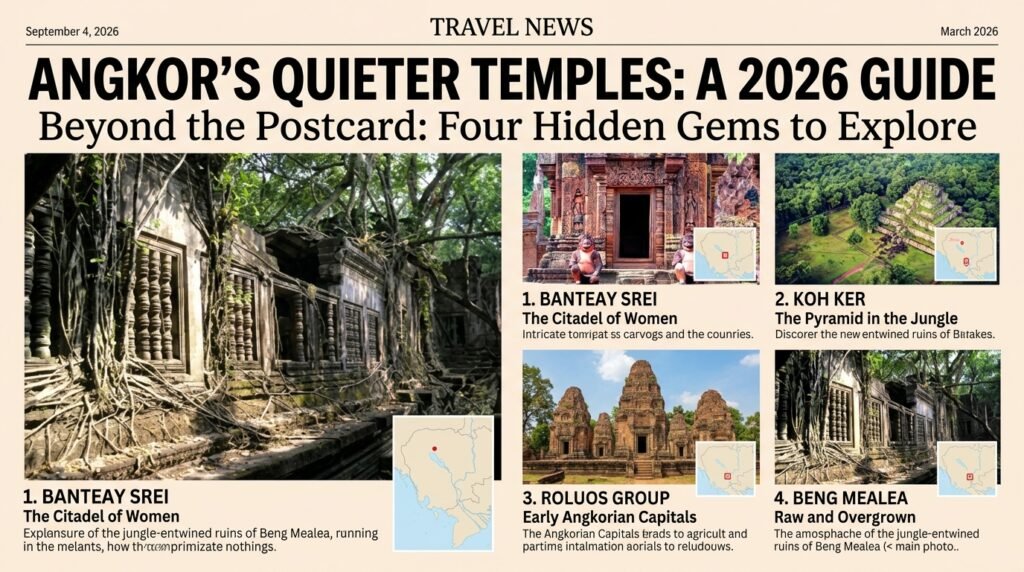
Angkor Wat at sunrise is the postcard. The real Angkor, however, lives in the quieter temples around it. Here is a 2026 guide to Beng Mealea, Banteay Srei, Koh Ker, and the Roluos Group — four hidden temple complexes every traveler should add to their list.
Angkor Wat pulls almost every traveler to Siem Reap. The sunrise shot at the reflection pools, the busy causeway, the long lines at Bayon and Ta Prohm — these are the images that define Cambodia for most visitors. The crowds are part of the experience, but they are not the whole story. The Angkor Archaeological Park stretches across more than 400 square kilometers. Outside the main small and grand circuits, a quieter, wilder Angkor waits.
This guide walks through four hidden temple complexes that reward travelers who go beyond the standard itinerary. Each site offers a different version of Cambodia’s ancient past. Beng Mealea gives you jungle ruin in its rawest form. Banteay Srei shows the finest stone carving in the country. Koh Ker, a 2023 UNESCO World Heritage Site, stuns with a seven-tier pyramid. The Roluos Group reveals the earliest Khmer capital. Together they turn a normal Angkor visit into a deeper, slower journey.
TRAVELER TAKEAWAY
Travelers who add two or three hidden temples to a Siem Reap trip get a richer, calmer experience. The crowds shrink, the photography improves, and the cost stays low. A 3-day Angkor Pass plus a Beng Mealea add-on ticket covers almost every site in this guide.
Start With the Right Angkor Pass
Before visiting any temple, buy the right pass. The Angkor Enterprise office, the official authority that manages the park, sells three ticket types. Prices in 2026 stay at the long-standing official levels. A one-day pass costs US$37. A three-day pass costs US$62 and stays valid for any three days inside a ten-day window. A seven-day pass costs US$72 and stays valid for one month from the issue date.
The three-day pass works best for most travelers. Day one covers the small circuit — Angkor Wat, Bayon, and Ta Prohm. Day two covers the grand circuit — Preah Khan, Neak Pean, Ta Som, and East Mebon. Day three goes beyond Angkor Thom to Banteay Srei and the Roluos Group. Beng Mealea and Koh Ker need separate tickets because they sit outside the main park. A separate Beng Mealea ticket costs US$5 at the site entrance.
Buy passes at the official Angkor Enterprise office on Apsara Road or through their official portal. Avoid third-party resellers who charge extra. Carry the pass with you at all times. Park rangers check tickets at every temple entrance.
QUICK FACTS — ANGKOR PASS 2026
| 1-Day Pass | US$37 — single day entry |
| 3-Day Pass | US$62 — any 3 days within 10 days |
| 7-Day Pass | US$72 — any 7 days within 1 month |
| Beng Mealea add-on | US$5 at site entrance |
| Opening hours | 5:00 AM – 5:30 PM (most temples) |
| Official seller | angkorenterprise.gov.kh |
Beng Mealea — The Jungle Labyrinth
Beng Mealea sits about 40 kilometers east of the main Angkor complex. The drive from Siem Reap takes around 90 minutes by tuk-tuk or one hour by car. The temple dates to the early 12th century and follows the same architectural style as Angkor Wat. The big difference is that nature took the site back. Trees grow straight out of the stone walls. Massive root systems drape across galleries. Piles of carved sandstone blocks lie where they fell centuries ago.
Travelers describe Beng Mealea as the closest you get to a true Indiana Jones moment in Cambodia. There is a wooden walkway that loops through part of the site, but most of the temple stays wild. Visitors climb over stones, duck under tree branches, and discover hidden carvings around every corner. The site sees far fewer visitors than Angkor Wat, so a morning here feels private and quiet.
The separate entrance fee costs US$5 at a ticket office about one kilometer from the temple gate. A round-trip tuk-tuk from Siem Reap costs around US$50. A private car with driver costs more but cuts travel time and adds comfort. The best time to visit is early morning, between 7:00 AM and 10:00 AM, when the light is soft and the air is still cool. Combine Beng Mealea with a visit to Banteay Srei on the way back to make a full day trip.
Banteay Srei — The Pink Sandstone Masterpiece
Banteay Srei sits 25 kilometers northeast of the main Angkor complex. The temple opens daily from 7:30 AM to 5:30 PM. A visit takes about 90 minutes to two hours. The site is small, exposed, and very different from the massive temples in the main park. It dates to 967 AD, earlier than Angkor Wat, and it carries the finest stone carving in the entire Angkor region.
The temple uses pink sandstone instead of the usual gray. Pink sandstone is harder than regular sandstone, so the carvings stay sharp even after a thousand years. Visitors see intricate lintels, delicate pediments, and detailed scenes from the Ramayana carved into almost every surface. The detail work amazes even travelers who already saw Angkor Wat.
The best time to visit is golden hour — between 3:30 PM and 5:00 PM — when the late sun warms the pink stone. Early morning between 7:30 AM and 9:00 AM also works well, before tour groups arrive. The site has very little shade, so avoid the middle of the day. Banteay Srei sits inside the main Angkor Pass, so no extra ticket is needed. A tuk-tuk round trip from Siem Reap costs about US$25.
PHOTOGRAPHY TIP
The pink sandstone at Banteay Srei glows in the last two hours before sunset. Plan your visit to end at 5:00 PM closing time, and you capture the warmest, softest light of the day on the most detailed carvings in Cambodia.
Koh Ker — The Newest UNESCO World Heritage Site
Koh Ker sits about 120 kilometers northeast of Siem Reap, in Preah Vihear province. UNESCO inscribed Koh Ker as a World Heritage Site in September 2023, making it Cambodia’s fourth UNESCO site. The complex served as the Khmer capital for a brief period in the 10th century. The standout structure is Prasat Thom, a seven-tiered pyramid temple that rises 30 meters above the jungle. It looks more like a Mesoamerican pyramid than a classic Khmer temple. Travelers often compare it to Chichen Itza or Tikal.
The site stayed off the tourist map for years because of landmine risk in the area. Demining work cleared the main zones, and the site now opens safely to visitors. The remote location keeps crowds low. Most travelers reach Koh Ker on a full-day private tour from Siem Reap. A car with driver costs around US$90 to US$120 for the day. A tuk-tuk is possible but adds travel time and rough road comfort.
Visitors need a separate entrance ticket for Koh Ker, sold at the site entrance. The fee supports local conservation work after the UNESCO inscription. Plan to spend three to four hours at the complex. The main pyramid, Prasat Thom, dominates the visit, but the surrounding smaller temples and the Linga ponds deserve time too. The best months to visit are November to February, when the temperature is mild and the dirt roads stay dry.
Roluos Group — The Earliest Khmer Capital
The Roluos Group sits about 13 kilometers southeast of Siem Reap. It contains three temples — Preah Ko, Bakong, and Lolei — that date to the late 9th century. This is where the Khmer Empire built its first major capital, Hariharalaya, before it moved to Angkor. The site sits inside the main Angkor Pass, so no extra ticket is needed.
Preah Ko is a small brick temple with six towers arranged in two rows. The brick carvings survive in remarkable condition. Bakong is the largest temple in the group, a five-tier pyramid surrounded by a moat. Lolei sits on an island in an old reservoir and features fine lintel carvings. The Roluos Group receives far fewer visitors than the main park, which makes it perfect for a quiet afternoon walk.
Travelers often visit Roluos as a half-day trip in the afternoon, after the main circuit in the morning. A round-trip tuk-tuk from Siem Reap costs about US$15. The drive takes 30 minutes. Combine Roluos with a stop at a local silk farm or a floating village on the Tonle Sap lake for a complete day.
A 3-Day Siem Reap Temple Itinerary
Travelers who want the full Siem Reap experience can follow this 3-day temple plan. The plan covers all four hidden temples in this guide plus the main Angkor complex. It fits inside a single three-day Angkor Pass.
- Day 1 — Main circuit. Sunrise at Angkor Wat. Late morning at Bayon and Baphuon inside Angkor Thom. Afternoon at Ta Prohm and Ta Nei. Sunset at Pre Rup.
- Day 2 — Grand circuit and Banteay Srei. Morning at Preah Khan, Neak Pean, and Ta Som. Afternoon at Banteay Srei for golden hour photography. Optional stop at the Landmine Museum on the way back.
- Day 3 — Hidden temples day. Early start to Beng Mealea (90 minutes by tuk-tuk). Continue north to Koh Ker for a full pyramid visit. Return via Roluos Group in the late afternoon for quiet temple time at sunset.
This plan moves at a calm pace. It still covers the icons but adds the depth that most travelers miss. Add a fourth day for the Tonle Sap floating villages, a Phare Cambodian Circus show in the evening, or a cooking class in a local village.
Practical Tips for Visiting Hidden Temples
A few practical habits make hidden temple trips smoother, safer, and more rewarding. These tips come from current travel forums, recent guidebooks, and on-the-ground traveler reports.
- Start early. Sunrise at hidden temples gives you cooler air, softer light, and almost no other visitors. A 6:00 AM start beats a 9:00 AM start every time.
- Carry cash. Most temple ticket offices, tuk-tuk drivers, and small food stalls take US dollars. Carry small bills — $1, $5, $10 — because change is hard to find.
- Wear modest clothing. Cover shoulders and knees at every temple. A light scarf works as a shoulder cover and a sun shield.
- Hydrate often. Cambodia stays hot year-round. Drink one liter of water per temple visit. Most tuk-tuk drivers carry a cooler with cold water for free.
- Use the Bakong Tourists app. Many hotels, restaurants, and tour operators in Siem Reap now accept KHQR payments. The app lets you pay by QR code from your phone, with no cash needed.
- Hire a licensed guide. A licensed guide costs about US$35–50 per day and adds enormous depth. Look for guides with official badges from the Apsara National Authority.
Respect the Stones, Respect the People
The hidden temples of Siem Reap are not just photo subjects. They are active religious sites, community assets, and irreplaceable heritage. Travelers who visit with respect help preserve them for the next generation. Do not climb on fragile carvings. Do not touch bas-reliefs with sunscreen on your hands. Do not leave trash. Do not buy ancient artifacts, real or fake, from informal sellers — this trade fuels looting.
Local communities around the temples benefit directly from tourism. Buy snacks, water, and souvenirs from village stalls near the temple entrances. Hire local tuk-tuk drivers and guides. Stay in locally owned guesthouses when you can. These small choices keep tourist dollars inside Cambodia.
Travelers who treat the hidden temples with respect also get a warmer welcome. Local guards, monks, and villagers often open doors that stay closed to rushed visitors. A smile, a slow pace, and a genuine interest in the place open more gates than any ticket.
The Real Angkor Is Bigger Than You Think
Angkor Wat deserves its fame. Every traveler should see sunrise at the reflection pool at least once. But the real Angkor lives beyond the main park. Beng Mealea shows the jungle in its rawest form. Banteay Srei shows what Khmer carvers achieved at their finest. Koh Ker shows a capital that once rivaled Angkor. The Roluos Group shows where the whole story started.
Travelers in 2026 have a rare window. The hidden temples are still quiet. The crowds still concentrate at Angkor Wat, Bayon, and Ta Prohm. A short tuk-tuk ride or a half-day car trip puts you in a different world. The cost stays low. The rewards stay high. The road opens today.