Cambodia Inflation Hits 5.1% in 2026: What Smart Investors See That Others Miss
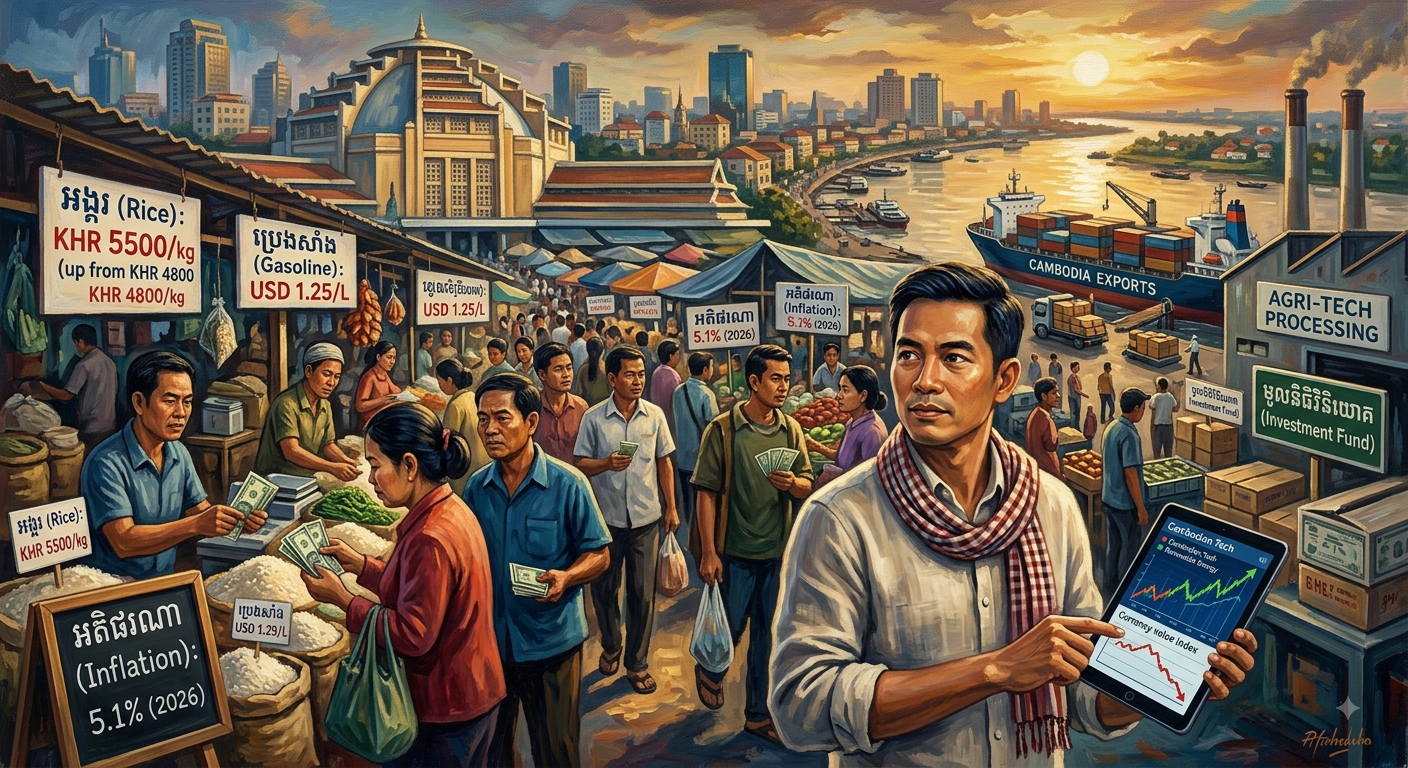
Cambodia is facing its highest inflation rate in years. The ASEAN+3 Macroeconomic Research Office, or AMRO, projects inflation at 5.1% for 2026. The International Monetary Fund puts the figure even higher at 5.6%. Consumer prices spike to 7.19% in May 2026 before easing slightly to 3.5% in June. Food prices, which account for 45% of Cambodia’s consumer price basket, keep climbing. Global energy costs add more pressure. These numbers make headlines. Most people read them and feel concerned. Smart investors read them and see something different. They see opportunity.
This article breaks down what is really happening with Cambodia’s inflation, why it is not as dangerous as it looks, and where the real investment opportunities sit. Every data point in this piece comes from verified public sources including the IMF, AMRO, the National Bank of Cambodia, the World Bank, and the Cambodia Investment Review.
The Numbers: A Clear Picture of Cambodia’s Inflation Reality
Let’s start with the facts. Cambodia’s inflation story in 2026 is a story of two halves. In January 2026, the annual inflation rate stands at just 1.26%, according to the National Bank of Cambodia. By April, it surges to 5.79% year-on-year. In May, it peaks at 7.19%, the highest reading in recent years. By June, it moderates back to 3.5% as global energy prices briefly stabilize. The average for 2025 is 2.5%, according to the IMF. The projections for the full year 2026 now sit between 5.1% (AMRO) and 5.6% (IMF). AMRO expects inflation to ease sharply to 2.8% in 2027 as global commodity prices moderate.
Compare this to the rest of ASEAN. Thailand reports inflation at just 0.9%. Malaysia sits at 1.9%. The global average stands at 3.1% according to the IMF World Economic Outlook. Cambodia is clearly running hotter than its neighbors. But this comparison alone does not tell the full story. The structure of Cambodia’s economy explains a large part of why inflation is higher and why it matters less than the headline number suggests.
Why Cambodia’s Inflation Is Different: The Dollarization Shield
Here is what most inflation analysis about Cambodia misses. Cambodia is one of the most highly dollarized economies in the world. More than 80% of all transactions in Cambodia use the US dollar. The riel, Cambodia’s national currency, circulates alongside the dollar in daily life. Most businesses price their goods in USD. Most contracts, including commercial leases and supply agreements, use the dollar. Most wages in the formal sector pay in dollars or a dollar-riel mix.
This dollarization acts as a massive shock absorber. When global energy prices rise, the price increase flows through directly in dollars. The riel does not crash. The National Bank of Cambodia does not need to defend a collapsing currency with aggressive interest rate hikes. And this is exactly what the data shows. The riel trades at 4,053 KHR per USD as of August 10, 2026. The average rate for 2025 is 4,011 KHR per USD, which means the riel actually appreciates by 1.5% that year. Over the twelve months from July 2025 to July 2026, the riel depreciates by just 0.53%. For an economy experiencing 5%+ inflation, this level of currency stability is remarkable.
The NBC has maintained the riel at approximately 4,000 per USD for more than two decades. This long-term stability means that dollar-based investors face virtually zero currency risk when they invest in Cambodia. If you put USD into a Cambodian business, your capital does not lose value through exchange rate depreciation. The same cannot be said for many other emerging markets in Southeast Asia or beyond.
What Is Driving the Price Surge
Three forces push Cambodia’s inflation higher in 2026. Understanding these forces is key to understanding where the investment opportunities sit.
First, food prices. Food accounts for 45% of Cambodia’s consumer price basket. This is the single largest component. The FAO Food Price Index averages 131.1 points in July 2026, up 0.6% from June. Global food supply chains remain under pressure from climate events, shipping disruptions, and trade policy shifts. Cambodia imports a significant portion of its processed food, cooking oil, and raw agricultural inputs. When global food prices rise, Cambodian consumers feel it immediately. AMRO warns of potentially swift second-round effects on food and core inflation.
Second, energy and oil costs. Cambodia imports nearly all of its refined petroleum. Global oil prices spike in early 2026, driven by Middle East tensions and supply constraints. Gasoline prices in Cambodia rise sharply through April and May, directly pushing up transportation costs, manufacturing costs, and the price of goods across every sector. The June easing to 3.5% inflation coincides with a temporary dip in global energy prices.
Third, supply chain reconfiguration. The shifting trade landscape, including new tariff structures and border adjustment policies, forces Cambodian businesses to reconfigure their supply chains. Some goods that previously came from one source now come from a more expensive alternative. This transitional cost shows up in consumer prices. The Cambodia-US Reciprocal Trade Agreement, signed in October 2025, creates both opportunities and short-term adjustment costs as businesses adapt to new trade flows.
The Numbers at a Glance
| Indicator | Value | Source |
|---|---|---|
| 2025 Average Inflation | 2.5% | IMF, July 2026 |
| 2026 Projected Inflation (AMRO) | 5.1% | AMRO, Jul 28, 2026 |
| 2026 Projected Inflation (IMF) | 5.6% | IMF, Jul 8, 2026 |
| 2027 Projected Inflation (AMRO) | 2.8% | AMRO, Jul 28, 2026 |
| CPI April 2026 | +5.79% YoY | Khmer Times / NBC |
| CPI May 2026 | +7.19% YoY | Trading Economics |
| CPI June 2026 | +3.5% YoY | World Bank CEU |
| Riel/USD (Aug 10, 2026) | 4,053 | NBC Official Rate |
| Riel 12-Month Change | -0.53% | WFP / NBC Data |
| Food Weight in CPI | 45% | AMRO Report |
| Dollarization Rate | 80%+ | NBC / World Bank |
Source: IMF, AMRO, NBC, World Bank, Khmer Times, Trading Economics (2025-2026)
What High Inflation Means for Investors: The Opportunities
Most commentary about inflation focuses on the negative side. Higher costs squeeze household budgets. Business margins come under pressure. Central banks face difficult policy choices. All of this is true. But for investors who understand the structure of Cambodia’s economy, inflation also creates specific, actionable opportunities.
Agriculture is the first and most obvious beneficiary. Food makes up 45% of Cambodia’s CPI basket. When food prices rise, agricultural producers, processors, and exporters benefit directly. Cambodia’s agricultural exports already hit nearly $5 billion in 2025 with 15 million tonnes shipped to global markets. Rising food prices mean higher revenues for rice millers, cassava processors, cashew exporters, and fruit packing operations. If you invest in a cassava drying facility or a cashew processing plant, inflation in food prices works in your favor. You sell your output at higher prices while your input costs, which are mostly local, do not rise as fast. This is the inflation hedge that most investors overlook.
Real assets offer protection. Inflation erodes the value of cash holdings. It pushes up the nominal value of real assets like land, buildings, and infrastructure. Phnom Penh’s residential property market shows price declines of 8.1% in 2026, but this is a cyclical correction from oversupply, not an inflation-driven decline. For investors with a long-term view, acquiring real assets in Cambodia during a period of cyclical price weakness and inflation means buying at a discount today and holding assets that appreciate in nominal terms as inflation persists. The key is to buy in the right locations and at the right point in the cycle.
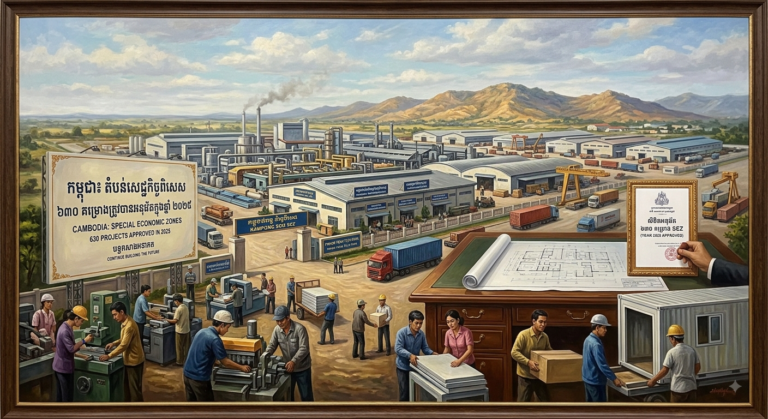
Export-oriented businesses gain a competitive edge. The riel is stable at around 4,050 per USD. While domestic prices rise due to imported inflation, Cambodia’s export prices remain competitive because the currency does not depreciate. In fact, the riel’s 0.53% depreciation over 12 months is negligible. This means Cambodian exporters do not lose pricing power in international markets. A garment factory, an electronics assembly plant, or an agricultural processing facility in Cambodia benefits from stable production costs in local currency while selling in dollars on the global market. The 63 Special Economic Zones across the country provide the infrastructure for exactly this kind of export-oriented investment.
The Monetary Policy Constraint: Why Cambodia Cannot Use Interest Rates
This is one of the most important and least understood aspects of Cambodia’s inflation story. In most countries, when inflation rises, the central bank raises interest rates to cool down the economy. The US Federal Reserve does this. The Bank of Thailand does this. The National Bank of Cambodia cannot do this effectively. The reason is dollarization.
When more than 80% of the money circulating in Cambodia is in US dollars, the NBC has very limited control over monetary conditions. It cannot print dollars. It cannot set the dollar interest rate. It cannot conduct open market operations in the currency that most businesses and consumers actually use. The NBC sets policy rates for the riel, but since most economic activity happens in dollars, these policy rates have a weak transmission mechanism. This is not a flaw. It is a structural feature of Cambodia’s financial system that has developed over decades.
What this means for investors is straightforward. Borrowing costs in Cambodia remain relatively low because the NBC cannot aggressively tighten monetary policy. If you borrow in dollars to fund a factory, a processing plant, or a real estate development, your interest rate environment stays favorable even during periods of elevated inflation. This is a significant advantage over many other emerging markets where central bank rate hikes make borrowing expensive during inflationary periods.
The Bakong Factor: Cambodia’s Quiet Financial Revolution
While inflation dominates the headlines, Cambodia is quietly building a modern financial infrastructure that addresses some of the underlying vulnerabilities in its monetary system. The Bakong payment system, launched by the NBC in 2020, is the world’s first central bank digital payment system. It allows real-time, 24/7 transactions in both the Cambodian riel and the US dollar. KHQR, the national QR code payment standard built on Bakong, creates a unified payment network that connects banks, mobile wallets, and payment providers across the country.
The NBC has been clear that Bakong is not a digital currency in the cryptocurrency sense. It is a payment system. But its impact on Cambodia’s financial system is profound. By moving more transactions from physical cash into the formal digital system, the NBC gains better visibility into economic activity. This improves the quality of monetary policy decisions over time. It also increases financial inclusion, bringing more Cambodians into the formal banking system. For investors, a more digitized and transparent financial system reduces transaction costs, speeds up payment cycles, and lowers the risk premium associated with operating in a cash-heavy economy.
The Investment Flow Paradox: Record Capital Despite Inflation
Here is the number that puts Cambodia’s inflation story in perspective. The National Bank of Cambodia reports net investment inflows of USD 4.3 billion in the first half of 2026, equal to 15.5% of GDP. The Council for the Development of Cambodia approves 276 investment projects worth $4.7 billion in fixed-asset investments in the same period. These projects are expected to create over 160,000 new jobs. The World Bank notes that foreign direct investment reaches $5.1 billion in 2025, creating an estimated 400,000 formal jobs.
These are not the numbers of an economy in crisis. They are the numbers of an economy that investors trust. Despite inflation running at 5%+, capital continues to flow into Cambodia at record levels. The reason is that global investors understand the structural factors behind the inflation. They know it is driven by external commodity prices, not by domestic monetary mismanagement. They know the riel is stable. They know the dollarization shield protects their capital. And they know that AMRO projects inflation to fall back to 2.8% in 2027, which would bring Cambodia back in line with regional norms.
What This Means for You as an Investor
Cambodia’s inflation is real, and it is above the regional average. But the story behind the number is far more nuanced than the headline suggests. The dollarization of the economy means your USD investments carry minimal currency risk. The riel’s two-decade track record of stability at around 4,000 per USD is one of the strongest in emerging Asia. The NBC’s inability to raise interest rates aggressively keeps borrowing costs favorable. Food inflation, which drives nearly half the CPI increase, directly benefits agricultural producers and processors. And record capital inflows confirm that global investors see beyond the headline number.
If you are an investor watching Cambodia, do not let the 5.1% headline scare you away. Look at the structure. Look at the riel’s stability. Look at where the inflation comes from and which sectors benefit. Look at the $4.7 billion in investment projects approved in just six months. The data is public. The opportunities are real. The question is whether you act on them.
Disclaimer: This article is for informational purposes only and does not constitute financial advice. All data is sourced from public authorities and verified news outlets. Investors should conduct their own due diligence before making any investment decisions.