Cambodia’s Investment Machine Delivers $2.5 Billion in a Single Quarter
146 Projects. 82,000 Jobs. One Quarter. Here Is Why Smart Money Is Moving Into Cambodia Right Now.
The Number That Changes the Conversation
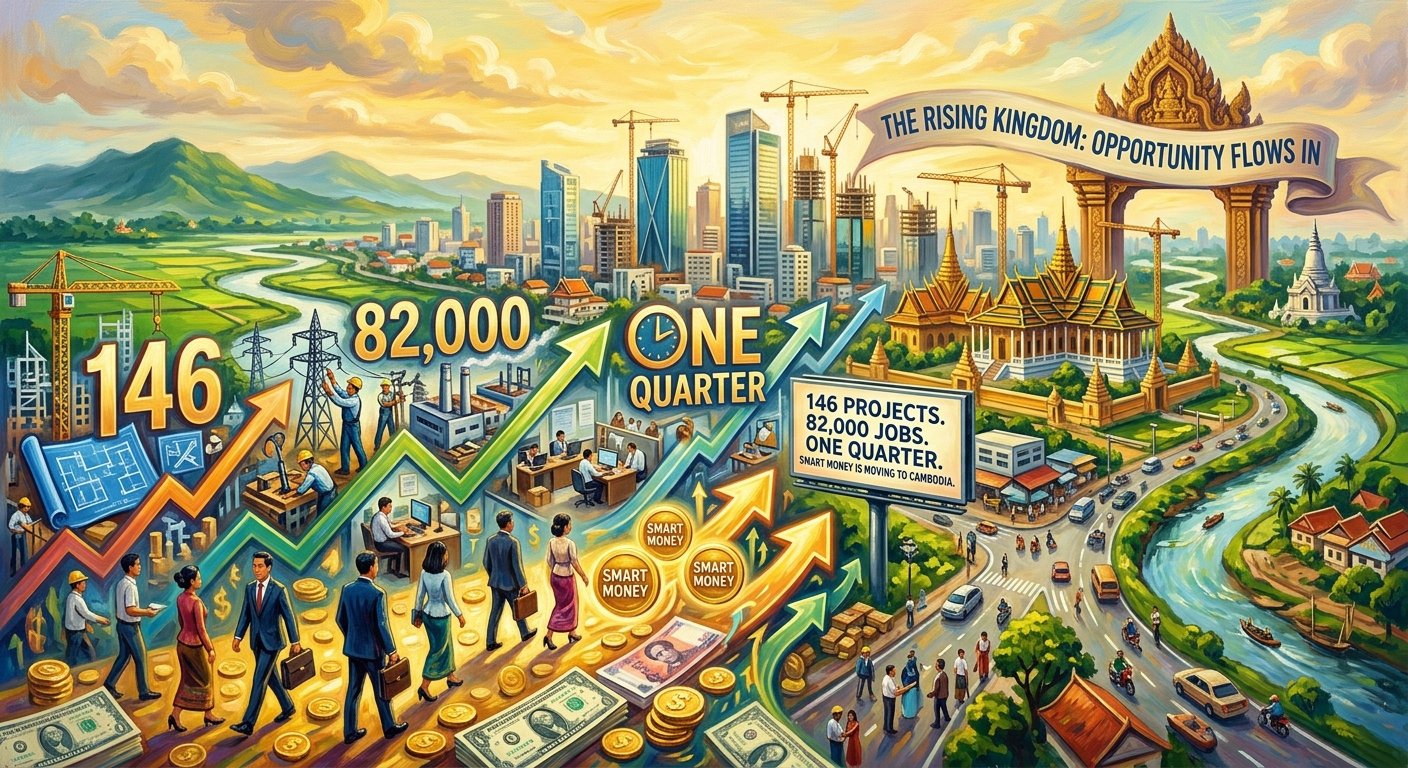
$2.5 billion. That is the total investment capital Cambodia registers in the first quarter of 2026. The Council for the Development of Cambodia, or CDC, approves 146 projects in just three months. These projects are expected to create more than 82,000 jobs. This is not an annual figure. This is a single quarter. If investment continues at this pace, Cambodia is on track to surpass $10 billion for the second consecutive year.
For context, consider the trajectory. In 2024, Cambodia approves 414 projects worth roughly $7 billion. In 2025, that number jumps to 630 projects worth nearly $10 billion. That is a 45 percent increase in project count and a 43 percent increase in capital. Now, in the first quarter of 2026 alone, the CDC registers 146 projects. The momentum is not slowing down. It is accelerating.
This kind of sustained investment growth is rare in any developing market. It signals that investors are not making one-time bets. They are committing capital, building factories, hiring workers, and establishing long-term operations. When you see numbers like these, the question is not whether Cambodia is a real investment destination. The question is how much of this opportunity you plan to capture.
Where the Money Goes: The Sector Breakdown
Not all investment is created equal. The quality of an investment boom depends on where the capital flows. In Cambodia’s case, the money is spreading across multiple productive sectors rather than concentrating in a single industry. This diversification is a sign of economic maturity and a lower-risk profile for new investors.
Manufacturing Leads the Way
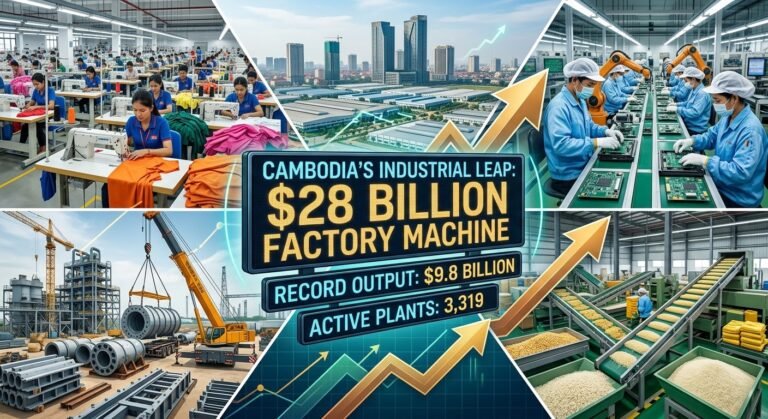
Manufacturing remains the dominant sector, accounting for the largest share of investment capital. But the composition is shifting fast. Traditional garment and textile manufacturing continues to grow, but the real story is non-garment manufacturing. EV assembly plants, motorcycle production lines, tyre factories, electronics assembly, and solar equipment manufacturing are all expanding rapidly. Cambodia is moving up the value chain, and investors who enter now benefit from both lower costs and a diversifying industrial base.
Agriculture and Agro-Processing
Large-scale agricultural investments and agro-processing facilities account for a growing share of new projects. Cambodia exports more than 11.89 million tonnes of agricultural products in the first ten months of 2025, with a total value exceeding $4.18 billion. The government targets nine strategic commodities: rice, cassava, cashews, rubber, bananas, durian, pepper, mango, and corn. Investment in processing facilities turns raw crops into higher-value export products. This is where the margin lives.
Infrastructure and Energy
Major infrastructure projects attract significant capital. The Funan Techo Canal, hydropower plants, solar farms, and wind power installations all feature in the 2025 and 2026 approval lists. Cambodia’s push for renewable energy creates opportunities in power generation, grid infrastructure, and energy storage. For infrastructure investors, the pipeline of mega-projects extends well beyond 2030.
Real Estate and Tourism
Real estate development, including mixed-use townships, condominiums, and tourism-related facilities, continues to attract foreign capital. The Cambodia real estate market is expected to grow at a compound annual growth rate of 10.1 percent through 2031, driven by population growth, tourism recovery, and urbanization. Investment-grade properties in Phnom Penh, Siem Reap, and coastal areas offer both rental yield and capital appreciation.
The Investor Lineup: Who Is Betting on Cambodia
Investment is only as good as the investors behind it. Cambodia’s investor base is diversifying, which reduces risk and broadens the opportunity set. Here is where the money comes from in the first half of 2026:
| Investor Source | Share of H1 2026 Capital | Key Sectors |
|---|---|---|
| China | 52.38% | Manufacturing, infrastructure, real estate |
| Cambodia (domestic) | 32.89% | Agriculture, services, retail |
| Singapore | 5.97% | Electronics, logistics, finance |
| Japan | Growing | Automotive parts, technology |
| South Korea | Growing | Textiles, electronics, construction |
| Vietnam | Growing | Agriculture processing, trade |
China remains the dominant source of foreign direct investment, contributing over half of total capital. But the headline number obscures an important trend. Domestic Cambodian investment accounts for nearly a third of all capital. This means local businesspeople are investing their own money alongside foreign investors. When domestic capital flows at this scale, it signals genuine confidence in the country’s economic direction.
Singapore’s presence is especially noteworthy. Singapore is one of the most disciplined and sophisticated capital markets in Asia. When Singaporean money flows into Cambodia’s electronics and logistics sectors, it means institutional investors have done their due diligence and found real returns. Japan and South Korea are also expanding their footprint, particularly in automotive components and electronics. This diversification of investor origin makes Cambodia’s investment environment more resilient to any single country’s economic fluctuations.
The Job Machine: What 82,000 New Jobs Per Quarter Really Means
Job creation is the most underappreciated metric in investment analysis. In Q1 2026, the 146 approved projects are expected to create more than 82,000 jobs. Across the full year of 2025, investment projects create 438,000 jobs. Cambodia adds 845 new factories in the first six months of 2026 alone. These are not projections. These are CDC-registered commitments from companies that have already received approval.
What does this mean for you as an investor? Jobs are demand. Every new factory worker needs housing, food, transportation, healthcare, and consumer goods. Every new mid-level manager needs apartments, restaurants, and entertainment. Every new facility needs suppliers, logistics partners, and service providers. A single manufacturing job creates an estimated three to five additional jobs in the broader economy. So 82,000 direct jobs potentially generate 250,000 to 400,000 indirect economic opportunities.
Cambodia’s labor force is young, growing, and affordable. The statutory minimum wage in the garment sector is $210 per month in 2026, with only a 1 percent increase from the previous year. Compare this to China, where manufacturing wages are five to eight times higher, or Thailand, where wages are three to four times higher. For labor-intensive businesses, this wage advantage directly translates into higher profit margins. The combination of a growing labor force and competitive wages is a structural advantage that is difficult for competitors to replicate.
2025: The Record Year That Set the Stage
To understand where Cambodia is going, you need to understand where it has been. The year 2025 is a turning point. The CDC approves 630 investment projects worth nearly $10 billion. This is an increase of 216 projects and $3 billion compared with 2024. The 438,000 jobs created in 2025 represent the strongest year on record for Cambodian investment.
| Metric | 2024 | 2025 | Change |
|---|---|---|---|
| Projects Approved | 414 | 630 | +52% |
| Investment Capital | $7 billion | $10 billion | +43% |
| Jobs Created | N/A | 438,000 | Record |
| FDI Inflows (NBC) | $4.4 billion | $5.2 billion | +18% |
| Greenfield FDI Ranking | N/A | No. 1 Asia-Pacific | New |
These numbers tell a clear story. Cambodia is not experiencing a random spike in investment. It is in the middle of a sustained, multi-year capital inflow that is accelerating. The 2025 figures establish a new baseline. The Q1 2026 data suggests the next baseline will be even higher.
Major projects approved in 2025 include large-scale agricultural and agro-processing investments, the Funan Techo Canal, hydropower installations, solar and wind power generation, EV assembly facilities, and multiple Special Economic Zone developments. These are not small-scale operations. They are industrial-grade investments that require long-term commitment from serious players.
The Policy Engine Behind the Numbers
Investment does not flow at this scale by accident. Cambodia’s government actively engineers a pro-investment environment through policy, legislation, and institutional support. The 2021 Law on Investment is the foundation. It provides incentives for 19 priority sectors and activities, including high-tech industries, innovative manufacturing, agriculture processing, green energy, and digital technology.
The Qualified Investment Project, or QIP, is the primary legal pathway to unlock these incentives. When your project receives QIP status from the CDC, you gain access to a comprehensive incentive package. This includes a corporate income tax holiday of up to nine years, exemption from import duties on machinery and raw materials, zero percent VAT on eligible imports, and 100 percent foreign ownership of your company. No local partner is required.
The CDC also operates an online portal called cdcIPM for investment registration and tracking. This digital system reduces processing times and improves transparency. The government is not just offering incentives. It is building the institutional infrastructure that makes investing in Cambodia straightforward and predictable. For investors who have navigated bureaucratic nightmares in other developing markets, this is a meaningful advantage.
What the GDP Slowdown Really Means for Investors
Honest analysis requires addressing the full picture. In July 2026, the IMF revises Cambodia’s GDP growth forecast downward to 3 percent for the year, citing higher energy prices, softer external demand, and the effects of the 2025 border conflict with Thailand. The World Bank projects 3.9 percent growth for 2026, with recovery to 4.9 percent in 2027. Both numbers are lower than the 5.2 percent growth Cambodia achieves in 2025.
Here is the insight that most commentators miss. GDP growth and investment growth do not always move in the same direction. In fact, they often move inversely during structural transitions. When a country invests heavily in infrastructure and manufacturing capacity, the GDP impact lags. Roads take years to build. Factories take time to reach full production. The investment happens first. The economic output follows.
Cambodia’s current situation is a textbook example. Investment is surging while GDP growth temporarily moderates. This means the country is planting seeds that will produce future growth. The $2.5 billion invested in Q1 2026, the $300 million World Bank transport program, the $1.16 billion Funan Techo Canal, and the $2.3 billion Techo Airport all represent capital deployed today for returns that materialize over the next five to ten years. For long-term investors, this divergence between investment and GDP growth is an opportunity, not a warning sign.
Risks Every Investor Should Weigh
Every investment market carries risk. Cambodia is no exception. The smart approach is to identify the risks and develop strategies to manage them.
Geopolitical sensitivity. Cambodia’s close relationship with China is a factor that some Western investors consider carefully. The practical reality is that the government actively welcomes investment from all countries. Singaporean, Japanese, European, and American companies all operate successfully in Cambodia. The investor base is diversifying, and the World Bank’s active involvement in transport and energy projects adds multilateral credibility.
Regulatory evolution. Cambodia’s regulatory framework continues to develop. Tax policies, labor laws, and investment procedures are still maturing. The solution is straightforward: work with a reputable local law firm or investment advisory firm that specializes in Cambodian regulation. They ensure your compliance is clean and your operations are protected.
Infrastructure gaps. While major infrastructure projects are underway, some areas still face challenges in power reliability, road quality, and logistics efficiency. The solution is to invest in established zones and corridors where infrastructure is already in place or under active development. Special Economic Zones, the Phnom Penh to Sihanoukville expressway corridor, and the AH21 corridor are all areas with strong infrastructure trajectories.
Currency considerations. Cambodia operates a dual-currency system where the US dollar is the dominant business currency. The Cambodian riel trades at approximately 4,040 to 4,055 KHR per USD and has depreciated by only 0.53 percent over the past year. For dollar-based investors, this effectively eliminates currency risk. Your revenue and costs are in the same currency.
How to Position Yourself in Cambodia Right Now
The investment data is clear. Cambodia is in the middle of a multi-year investment surge that shows no signs of slowing. The policy environment is pro-investment. The labor force is young and affordable. The currency is dollarized. The government welcomes 100 percent foreign ownership. The question is how you turn these macro conditions into a concrete investment strategy.
If you are in manufacturing, evaluate Special Economic Zones in Phnom Penh, Sihanoukville, or Bavet. The QIP incentive package gives you up to nine years of tax-free operations. If you are in agriculture, look at northeastern provinces where the World Bank’s AH21 transport upgrade is making agro-processing viable for the first time. If you are in real estate, target mixed-use developments near Phnom Penh and Siem Reap where tourism and urbanization drive demand. If you are in infrastructure, review the World Bank’s published procurement plans and the CDC’s project approval lists for contract opportunities.
The numbers speak for themselves. $2.5 billion in a single quarter. 146 projects. 82,000 jobs. $10 billion in 2025. 630 projects. 438,000 jobs. This is not speculation. This is capital deployment at scale. Cambodia is building something real. The opportunity is to be part of it.