
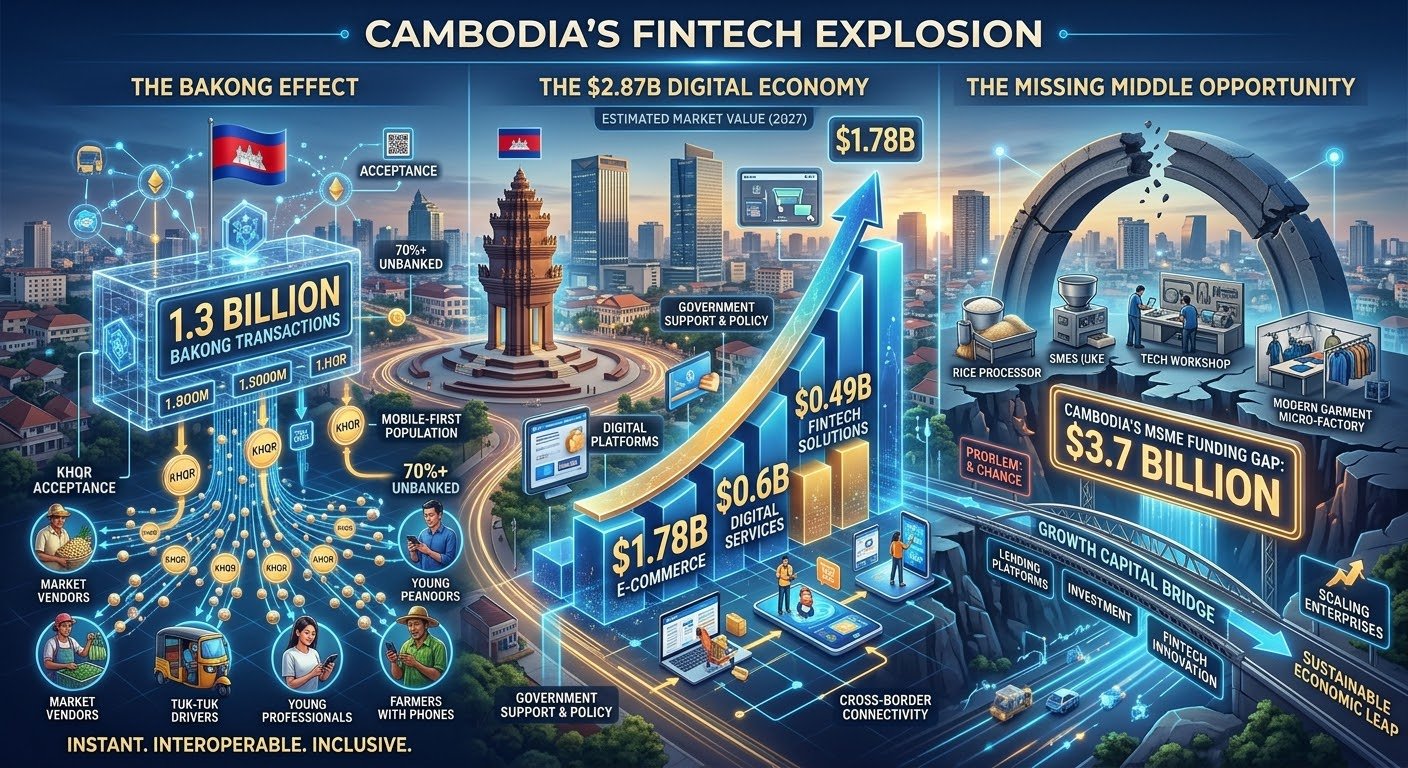
Cambodia’s Fintech Explosion: 1.3 Billion Bakong Transactions, $2.87B Digital Economy, and the Missing Middle Opportunity
How the world’s first retail DLT payment system, 70-90 fintech firms, and 5 ASEAN cross-border QR linkages are creating a once-in-a-decade investment window
The Numbers That Define Cambodia’s Fintech Moment
Cambodia’s fintech sector is no longer an emerging story. It is an established, data-validated investment thesis. The Bakong payment system processes 1.3 billion transactions annually. The digital economy is projected to reach $2.87 billion by 2027, up from $1.62 billion in 2023. E-commerce revenue sits at $1.2 billion with 4.5 million users and 38 percent penetration. An estimated 70 to 90 fintech firms operate across the country, spanning digital payments, e-wallets, digital lending, insurtech, and wealthtech. Cambodia now ranks second only to Thailand in cross-border payment integration within ASEAN, with bilateral QR linkages connecting five neighboring economies. These are not projections. These are live, verifiable, growing numbers. For investors seeking exposure to Southeast Asia’s digital economy, Cambodia represents one of the most compelling risk-reward profiles in the region, driven by a young, mobile-first population, a central bank that actively champions innovation, and a regulatory framework that is adapting faster than many of its regional peers.
Bakong: The World’s First Retail DLT Payment System
Launched in October 2020 by the National Bank of Cambodia and built by Japanese fintech company Soramitsu, Bakong is the world’s first central bank-backed payment system built on distributed ledger technology to operate at national retail scale. In 2025, the system processed 1.325 billion transactions, a 20 percent increase over the previous year. Of these, 771 million transactions are conducted in Khmer riel, valued at KHR 129 trillion (approximately $32 billion), while 554 million transactions are in US dollars, valued at approximately $152.8 billion. NBC Governor Chea Serey has clarified that Bakong is not a central bank digital currency in the traditional sense. Rather, it is a backbone payment infrastructure that connects all financial institutions and payment providers on a common, interoperable platform, enabling peer-to-peer and wallet-based transactions in real time, 24 hours a day, seven days a week. The system supports both KHR and USD, which is critical in Cambodia’s dual-currency environment where the US dollar circulates alongside the riel. For investors, Bakong’s significance extends far beyond payments. It is the foundational infrastructure upon which lending, insurance, wealth management, and e-commerce applications are being built. Every fintech in Cambodia either integrates with Bakong or competes against it, which means the system’s growth trajectory directly shapes the entire sector’s opportunity set.
| Metric | 2023 | 2024 | 2025 | Growth |
|---|---|---|---|---|
| Total Transactions (billions) | 0.92 | 1.10 | 1.33 | +20% YoY |
| KHR Transactions (millions) | 530 | 650 | 771 | +19% |
| USD Transactions (millions) | 380 | 460 | 554 | +20% |
| KHR Value (trillion) | 85 | 108 | 129 | +19% |
| USD Value ($B) | 110 | 130 | 152.8 | +18% |
The Fintech Ecosystem: 70-90 Firms and a Cashless Transition
Cambodia’s fintech landscape is denser than many international investors realize. By 2026, an estimated 70 to 90 fintech firms operate across the country, ranging from payment providers and e-wallets to digital lending platforms, insurtech startups, and wealth management applications. The dominant players include Wing Bank (which evolved from a mobile money service into a fully licensed digital bank), ABA PAY (the mobile payments arm of Cambodia’s largest commercial bank by customer base), TrueMoney, Pi Pay, and Clik. The numbers tell the financial inclusion story: as of 2025, Cambodia records 18.9 million e-wallet accounts, 18.6 million deposit accounts, and 4.3 million credit accounts. In a country of 17.9 million people, e-wallet penetration effectively exceeds the total population, reflecting the fact that many users maintain multiple accounts across different platforms. The Asian Development Bank notes that fintech and e-commerce dominate the tech startup landscape in Cambodia, as opposed to education or health technology verticals. The NBC regulates the sector through a framework that requires e-wallet issuers to obtain licenses and comply with operational standards, with a November 2026 deadline for all wallet providers to formalize their status. This regulatory tightening is positive for investors because it creates barriers to entry, reduces informal competition, and establishes a clearer path for M&A activity among licensed players.
Key Fintech Verticals in Cambodia
- Digital Payments and E-Wallets: Bakong, Wing, ABA PAY, TrueMoney, Pi Pay, Clik — the most crowded and competitive segment
- Digital Lending: Early-stage platforms offering micro-loans and BNPL (Buy Now Pay Later), powered by Bakong transaction data for credit scoring
- Insurtech: Emerging platforms distributing micro-insurance products through e-wallet interfaces, targeting the 18.9M wallet user base
- Wealthtech and Robo-Advisory: Nascent segment serving the growing middle class with investment products, linked to the CSX capital market expansion
E-Commerce at $1.2 Billion and Accelerating
Cambodia’s e-commerce market is reaching a critical mass that transforms it from a niche opportunity into a mainstream investment category. As of April 2026, total e-commerce revenue sits at $1.2 billion, with 4.5 million e-commerce users representing 38 percent penetration of the population. The market is projected to reach $1.81 billion by 2029, driven by increasing internet penetration, a young tech-savvy population, and the Bakong payment infrastructure that enables seamless mobile transactions. The broader digital economy, which encompasses e-commerce, digital services, platform economics, and the enabling technology infrastructure, is projected to reach $2.87 billion by 2027, up from $1.62 billion in 2023. This represents a compound annual growth rate of approximately 15 percent, significantly outpacing GDP growth. The e-commerce growth is concentrated in food delivery, fashion and beauty, electronics, and general merchandise. Key platforms include Shopee, Lazada, and locally grown marketplaces. The connection between Bakong and e-commerce is direct: the instant payment capability eliminates the friction that historically constrained online shopping in a cash-heavy economy. For investors, the e-commerce opportunity in Cambodia is not about building the next Amazon. It is about providing the infrastructure, logistics, payment processing, and last-mile delivery that enables the market to grow from $1.2 billion to $3 billion and beyond.
Cross-Border QR: 5 ASEAN Linkages, Second Only to Thailand
Cambodia is emerging as a regional leader in cross-border digital payments, an achievement that has significant implications for trade, tourism, and investment flows. The National Bank of Cambodia has established bilateral cross-border QR payment linkages with five key ASEAN nations: Thailand, Vietnam, Lao PDR, Singapore, and Malaysia. With these five bilateral QR payment links now operational, Cambodia ranks second only to Thailand in cross-border payment integration within ASEAN. The practical impact is substantial. Cambodian tourists traveling to Thailand can use their mobile banking applications to scan Thai QR codes and pay directly from their Cambodian bank accounts in real time, with no intermediary and no traditional remittance fees. Vietnamese visitors to Cambodia enjoy the same convenience in reverse. This cross-border infrastructure reduces transaction costs, increases tourism spending efficiency, and creates a platform for broader economic integration. For investors, cross-border payment integration means that a fintech investment in Cambodia is not limited to a 17.9 million domestic market. It extends to the entire ASEAN economic community of 680 million consumers through interoperable payment rails. This regional reach dramatically expands the addressable market and makes Cambodian fintech platforms potential acquisition targets for larger regional players seeking ASEAN-wide coverage.
| Cross-Border Partner | Status | Key Use Case |
|---|---|---|
| Thailand | Operational | Tourism payments, trade settlement |
| Vietnam | Operational | Bilateral trade, worker remittances |
| Lao PDR | Operational | Cross-border trade, tourism |
| Singapore | Operational | Investment flows, business payments |
| Malaysia | Operational | Tourism, trade settlement |
Digital Infrastructure: 5G, 21.7 Million Mobile Connections, and 2,000+ Base Stations
Cambodia’s digital economy growth is underpinned by physical infrastructure that is advancing rapidly. The country has 17.9 million people, 21.7 million mobile connections, and 12.0 million internet users, representing 131.5 percent mobile penetration. The government has officially launched commercial 5G services in 2026, with more than 2,000 new 5G base stations deployed in just six months. This 5G rollout is not merely a consumer convenience. It is the infrastructure layer that enables next-generation applications in fintech, e-commerce, smart manufacturing, and digital government services. The combination of 5G connectivity, Bakong payment rails, and a young, mobile-first population creates a uniquely fertile environment for digital business models. Cambodia’s median age is approximately 27 years, which means the workforce and consumer base are digital natives who adopt mobile services instinctively. The Ministry of Post and Telecommunications is actively promoting 5G adoption to support smart city initiatives, industrial digitization, and the broader digital economy strategy. For infrastructure investors, Cambodia’s 5G rollout represents an opportunity in tower construction, fiber optic backhaul, data center development, and network equipment supply.
| Indicator | Value | Growth / Note |
|---|---|---|
| Population | 17.9 million | Young, median age ~27 |
| Mobile Connections | 21.7 million | 131.5% penetration |
| Internet Users | 12.0 million (2026) | Up from 10.8M in 2025 |
| 5G Base Stations (new) | 2,000+ in 6 months | Commercial 5G launched 2026 |
| E-Wallet Accounts | 18.9 million | Exceeds total population |
| E-Commerce Revenue | $1.2 billion (Apr 2026) | 38% user penetration |
| Digital Economy (projected) | $2.87B by 2027 | From $1.62B in 2023 |
The Startup Strategy 2026-2030 and the $7.2 Million Problem
On August 11, 2026, Cambodia launched its National Strategy on Startup Development 2026-2030, a comprehensive policy framework designed to build a vibrant, advanced, and inclusive startup ecosystem. The strategy is powered by the Techo Startup Center and Khmer Enterprise, both government-backed institutions that provide mentorship, co-working space, and connection to regional investor networks. The government aims to transform Cambodia into a technology-driven economy where startups contribute meaningfully to GDP growth and job creation. However, the strategy faces a critical bottleneck: the “missing middle” financing gap. Between 2023 and 2025, Cambodian startups received only about $7.2 million in equity funding, a figure that is strikingly low compared to regional peers. Vietnam raises billions annually; even Laos attracts proportionally more venture capital. This financing gap is both the sector’s biggest challenge and its most compelling investment opportunity. The $7.2 million figure means that early-stage Cambodian startups are significantly undervalued relative to their growth potential. For venture capitalists and angel investors, this creates a rare entry point where dollar deployment goes further, equity stakes are larger, and the upside from ecosystem maturation is substantial. The government’s startup strategy explicitly addresses this gap by creating frameworks for investor protection, tax incentives for startup investment, and co-investment mechanisms. The arrival of Plug and Play in Phnom Penh in 2025, focused on industrial supply chains and technology, signals growing international interest in bridging this financing gap.
Why the $7.2M Gap Is an Opportunity
The low equity funding total reflects a supply-demand imbalance. Cambodian founders are building real products with real users, as evidenced by the 1.3 billion Bakong transactions and $1.2 billion e-commerce market. But the pool of growth-stage capital is shallow. This creates a window for investors who deploy capital now to capture outsized returns as the ecosystem matures. Historical parallels include Vietnam in 2015-2018 and Indonesia in 2013-2016, where early movers who invested before the VC wave arrived generated the highest multiples. Cambodia’s digital economy is at a similar inflection point, but with valuations that are a fraction of what Vietnam and Indonesia commanded at comparable stages.
Financial Inclusion: 18.9 Million E-Wallet Accounts and the Unbanked Opportunity
Cambodia’s fintech story is fundamentally a financial inclusion story. A decade ago, nearly 50 percent of the adult population lacks access to traditional bank accounts, and less than 10 percent borrows from formal financial institutions. Today, 18.9 million e-wallet accounts exist in a country of 17.9 million people, effectively achieving universal digital financial access. The National Bank of Cambodia drives this transformation through the Financial Sector Development Strategy 2025-2030, which prioritizes digital financial literacy, expanded banking access, and the integration of underserved populations into the formal financial system. The NBC is collaborating with the Cambodia Bankers Association to push nationwide digital financial literacy programs, recognizing that adoption alone is insufficient. Users need the knowledge to manage digital finances responsibly. For investors, the financial inclusion trajectory points to three specific opportunities. First, digital micro-lending platforms that use Bakong transaction data for credit underwriting serve a population that traditional banks overlook. Second, micro-insurance products distributed through e-wallet interfaces address a massive protection gap. Third, digital savings and investment products that help the newly banked population build wealth create long-term asset management opportunities. Each of these verticals is at an early stage in Cambodia, meaning first-mover advantages are still available.
Investment Playbook: Where Smart Money Is Going in Cambodian Fintech
Cambodia’s fintech sector offers four high-conviction investment opportunities for 2026 and beyond. First, payment infrastructure and Bakong-integrated platforms benefit from the system’s 20 percent annual transaction growth and the expansion of cross-border QR linkages. Companies that build value-added services on top of Bakong, such as merchant analytics, loyalty programs, or invoice management, capture growth without competing directly with the central bank’s free-to-use rails. Second, digital lending and credit scoring is the highest-impact opportunity given the 18.9 million e-wallet users who generate transaction histories but lack formal credit profiles. Third, e-commerce enablers including logistics, warehousing, and last-mile delivery benefit from the $1.2 billion market growing toward $3 billion. Fourth, the “missing middle” VC opportunity offers the most asymmetric risk-reward. Deploying $500,000 to $2 million into growth-stage Cambodian startups today means acquiring meaningful equity stakes at valuations that regional consolidation will multiply. The risks include regulatory uncertainty as the NBC formalizes the e-wallet framework, competition from deep-pocketed regional players like Grab and Sea Group, and macroeconomic factors such as riel depreciation or US tariff impacts. However, the structural drivers, young population, mobile-first behavior, and government commitment to digital transformation, are durable. Cambodia’s fintech explosion is not a speculative bet. It is a data-backed investment thesis supported by 1.3 billion annual transactions, 18.9 million digital accounts, and a central bank that is building the rails.
Four High-Conviction Fintech Opportunities
- Payment Infrastructure: Build value-added services on Bakong’s 1.3B transactions. Merchant SaaS, analytics, loyalty, and cross-border settlement.
- Digital Lending: 18.9M e-wallet users with transaction data but no credit scores. Micro-loans, BNPL, and SME lending.
- E-Commerce Enablers: $1.2B market growing to $3B+. Logistics, warehousing, last-mile delivery, and seller tools.
- Growth-Stage VC: $7.2M total equity funding 2023-2025 means undervalued startups. Deploy $500K-$2M for outsized stakes.